Most orthopedic dog beds for golden retrievers are mats with a nicer word printed on the box. I have pulled 2 inches of foam out of a bed that promised orthopedic support, laid it on the garage floor next to a ruler, and watched it flatten under a 95-pound dog inside one season.
Biscuit is my 95-pound, 6-year-old golden, and he has killed more zippers than I can count. Maple is 60 pounds, 3 years old, and breaks out in a rash if a cover holds onto detergent. Between the two of them, bed shopping stopped being a style question years ago. It is a measurement question, and it comes down to three numbers: the length of your dog from chest to tail, the depth the foam sinks under your dog's weight, and the number of wash cycles the cover survives before the seams give.
Run those three checks before you spend anything, and most of the beds in the pet aisle eliminate themselves.
Why you should trust me
I spent 8 years as a vet tech before I started writing about gear full time, so I look at a dog's hips and elbows as a clinical problem before I look at them as a comfort problem. I have tested more than 60 dog beds over 10 years, and I still keep the notebook: foam sink depth every 6 months, bed weight after washing, the date a zipper fails.
The notebook is the point. A review that says "my dog loves it" tells you nothing about whether the foam held up. A review that says the foam sank a quarter inch in 6 months and the cover came out of the wash with the liner still attached tells you almost everything. When I say a bed flattens, I mean I measured it. When I say a bed is a pancake, I mean the ruler is on the floor next to it.
I also have a bias I will admit up front. I do not like cheap gear, but I do not trust expensive gear either. The only price comparison that means anything is cost per day: the price divided by the usable days you get out of the bed. A bed that dies in 4 months costs more per day than a bed that lasts 2 years, no matter how far apart the two stickers look.
How I picked and how I tested
I did not pick the two beds below because they are the biggest names. I picked them because they fill the two jobs a golden retriever owner actually needs filled: a crate pad for the puppy months and a large foam sofa for the adult years.
Every bed I consider gets the same checklist. Foam density first, because density is the whole ballgame. Furniture-grade foam runs 3 to 4 pounds per cubic foot, and that holds up under a big dog. Foam at 1.5 to 2 pounds per cubic foot is a scam dressed in the word orthopedic, and it will flatten within months under a 90-pound dog. Then the cover: can it go in the machine, and does the zipper survive the trip? Then the base: does the bottom grip a hardwood floor when a dog launches off it? Then the liner: is it actually waterproof, and does it still breathe?
I run the sink test on every bed with my own weight, because a hand press tells you nothing. Kneel on the foam, measure how far it compresses with a ruler, and write the number down. Anything that sinks more than an inch and a half under a kneeling adult is going to be a pancake under a golden.
One more thing about how I test: I do not trust the word orthopedic, the word premium, or the word waterproof until the spec sheet or the ruler proves it. Those words are marketing, not measurements.
Measure your dog before you buy anything
Step one is the tape measure, not the shopping cart.
Weight. Weigh your golden at the vet or on a home scale. A 95-pound dog and a 60-pound dog need different foam, and the difference is not small.
Length. Measure from the front of the chest to the base of the tail while your dog is standing. Add 6 inches. That is the minimum bed length. A golden that stretches out in his sleep needs a bed longer than he is tall, because dogs sprawl.
Sleeping position. Watch your dog for a week. A curler can use a smaller bed. A sprawler who lies across the whole thing, which is what Biscuit does, needs a flat rectangle with no rim stealing usable space.
Elbow-to-floor height. For a senior golden with sore elbows, measure how far the elbow sits off the floor when he lies down. A bed that is too thick is hard to climb onto. A bed that is too thin puts the joint on the floor.
Crate math. If the bed goes inside a crate, measure the crate interior and subtract 2 inches. A pad that fills the crate wall to wall is a pad your dog cannot rearrange.
Get those five numbers in the notebook, and the shopping list writes itself.
The two beds I would put in front of a golden owner
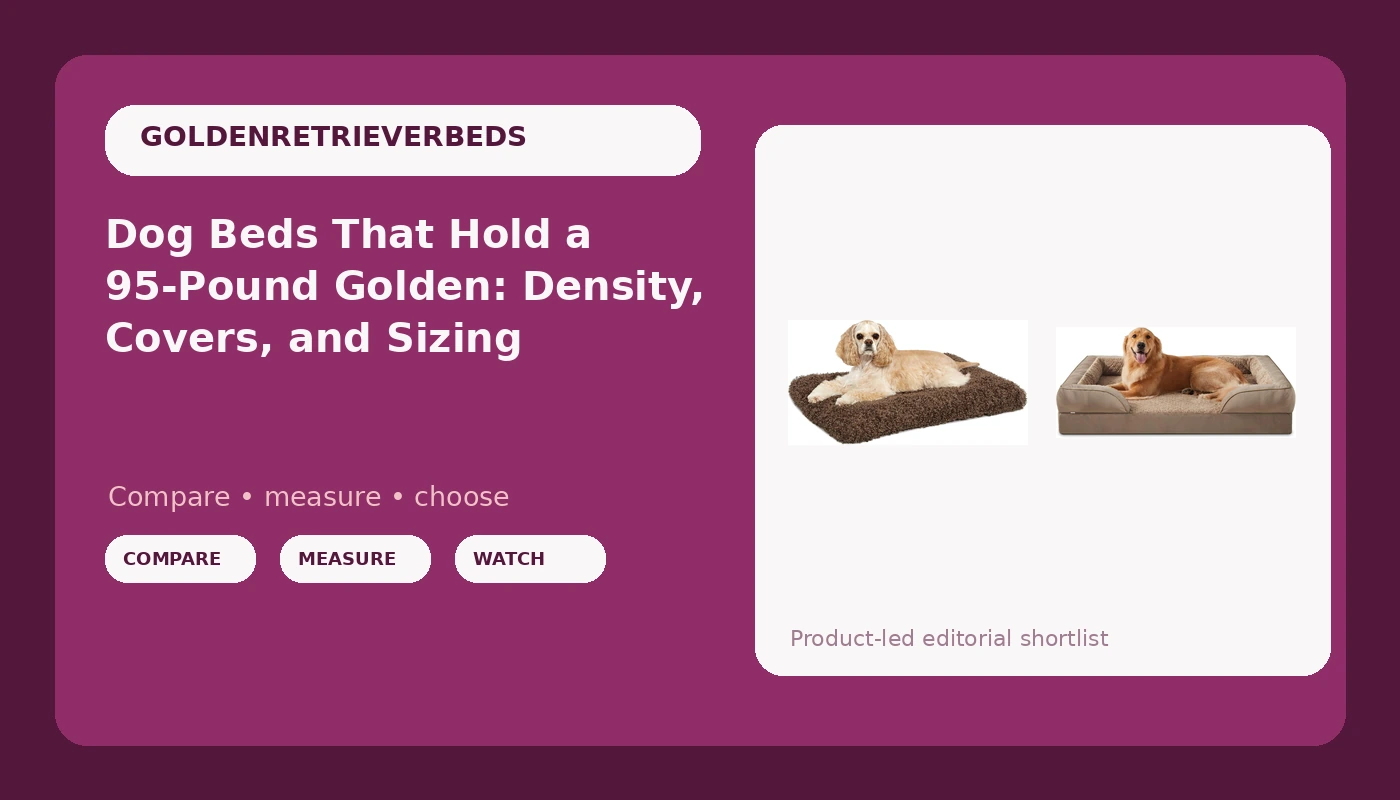
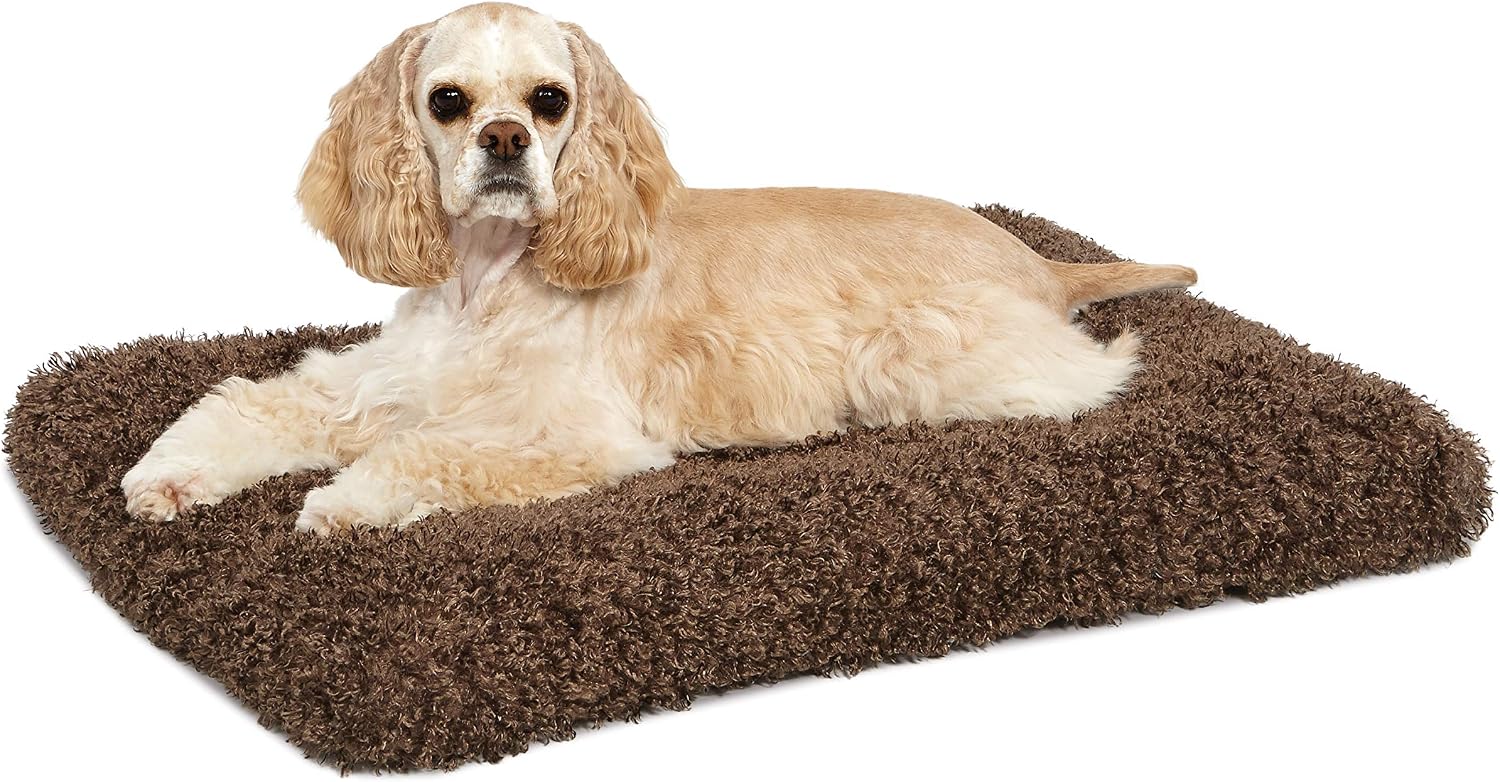
Crate pad and puppy pick: MidWest Homes for Pets Medium QuietTime Deluxe Coco Chic Pet Bed, Ultra-Soft & Overstuffed, Machine Washable, Fits 30-inch Crate
 Visit on Amazon →
This is an overstuffed, ultra-soft crate pad that is machine washable and sized to fit a 30-inch crate. Read the size honestly: it is a medium pad, so it is a puppy bed, a crate bed for a smaller golden, or a secondary bed in the corner of the living room. Maple at 60 pounds uses a pad this size fine. Biscuit at 95 pounds spills off both ends of it, and a big dog who spills off the end of a pad ends up sleeping on the floor with his chin on the cushion, which is not the deal you are paying for.
Where this earns its place is the puppy months. Puppies chew, puppies have accidents, and puppies do not deserve a foam investment. A washable overstuffed pad that fits the crate you already own is the right first bed, and when the dog outgrows it you move it to the car or the laundry room instead of throwing it out.
Flaws but not dealbreakers: Overstuffed fiber does not support a joint the way a dense foam slab does. It is comfort, not orthopedics, no matter how soft it feels. Fiber pads also compress over time and need fluffing after each wash.
Anyone with a golden puppy, a 30-inch crate, or a smaller adult golden will get real use out of this. Owners of a full-grown 90-pound dog should read the next section.
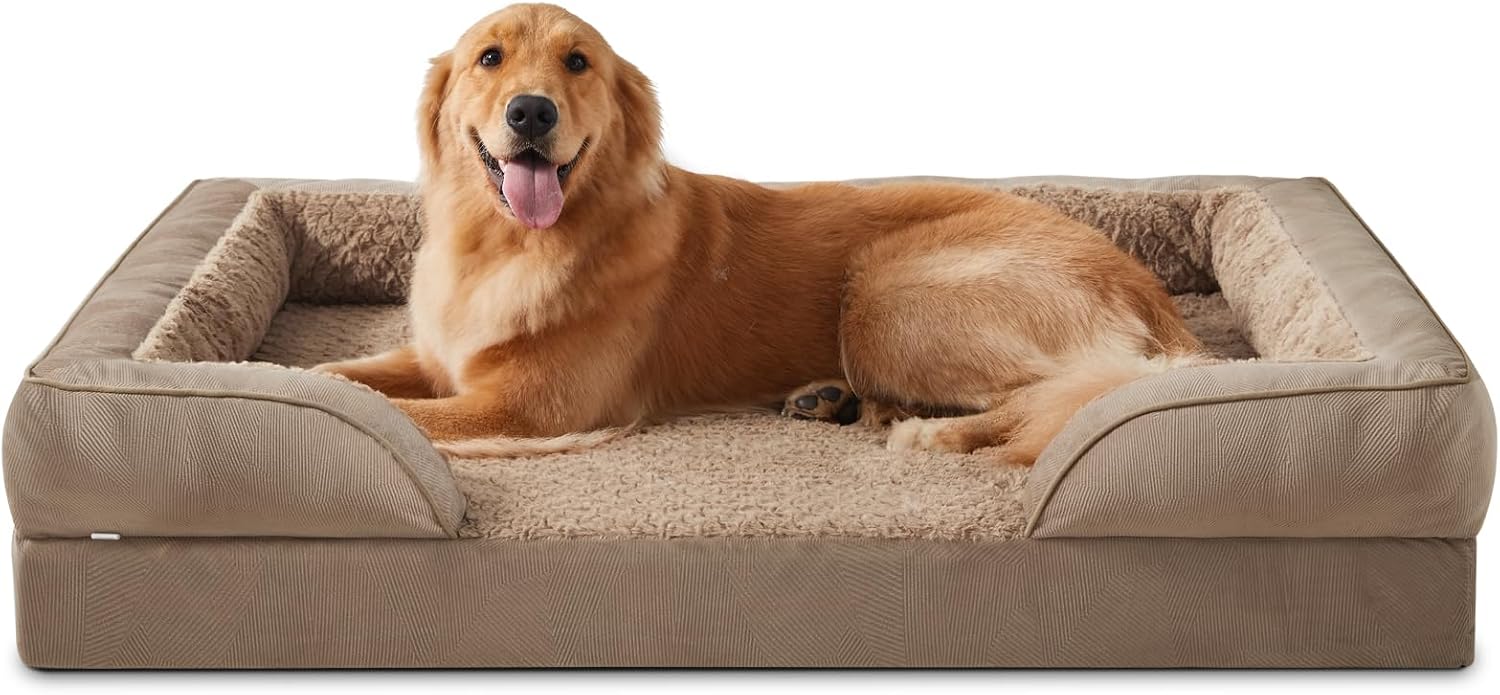
Main bed pick: INVENHO Orthopedic Dog Beds Large Sized, XL Washable Dog Sofa with Egg-Crate Foam, Waterproof Lining and Non-Skid Bottom
 Visit on Amazon →
This is the XL sofa shape with egg-crate foam, a waterproof lining, a washable cover, and a non-skid bottom. That spec list covers the four things I check first: a big footprint, foam, a liner that keeps accidents out of the core, and a base that does not slide when a 90-pound dog jumps off.
The honest note is about the foam itself. Egg-crate foam relieves pressure, and the bumps spread a dog's weight across more surface, which is genuinely good for elbows and hips. But egg-crate is not the same as a solid slab of 3 to 4 pound density foam, and it compresses more under a big dog. So run the sink test the day it arrives. Kneel on it, put the ruler down, and write the number in the notebook. Then re-measure at 90 days. If the foam has lost more than half an inch in that window, the bed is telling you what its future looks like, and you should use the return window while you still have it.
Flaws but not dealbreakers: A sofa shape with a rim wastes usable sleeping space if your dog sprawls. Biscuit lies across the whole bed and ignores bolsters entirely, so I look for a flat deck with low edges for him. Maple, who curls, would use the rim as a headrest.
Anyone with a full-grown golden who wants a large washable bed with a waterproof liner and a grip bottom should start here. Owners of a senior dog who struggles to climb should measure the step-up height first.
The setup workflow
A bed is not done when it comes out of the box. This is the routine I run in my own house.
Step one: measure the foam on day one. Ruler, notebook, date. That is your baseline, and without it you have no way to prove the bed flattened.
Step two: run the sink test. Kneel on the bed and measure the compression. Under an inch is good. Over an inch and a half is a warning.
Step three: inspect the cover before the first wash. Zip it, look at the teeth, tug the seam. A zipper that already catches on day one is a zipper that fails in month four.
Step four: wash cold, air dry. Heat is what kills a waterproof liner and shrinks a cover until it will not zip back on. Wash the cover alone, cold, gentle cycle, then hang it. If the liner delaminates after one wash, send the bed back and say so in your notes.
Step five: put the bed where the dog already sleeps. The base of operations gets chosen by the dog, not by your living room layout. Biscuit camps where he can watch the front door. A bed in the wrong room is a bed nobody uses.
Step six: fix what is fixable. A zipper can be replaced. A torn seam can be patched. A cover that has gone bald and a foam core that has flattened cannot be saved. I draw the line at the foam, because that is the part that touches the joints.
Step seven: re-measure at 90 days and again at 6 months. Two numbers in the notebook tell you whether this bed is a 2-year bed or a 6-month bed. That is the whole decision.
What I skipped and why
Donut beds do not belong in a golden's house. A 90-pound dog turns one into a pancake with a rim, and the rim steals the space the dog actually needs.
Cooling gel beds work in a Colorado summer, but the cheap ones burst, and then you are cleaning gel off the floor at 11 p.m. If you want cooling, buy it from a brand that will stand behind the liner.
Big Barker is the bed I bought twice for my own dogs, and two years in the foam still holds shape. It is also the most expensive option on this page by a wide margin, and I will not pretend a bed that costs several times more is the right answer for everyone. It is the right answer for owners who keep a bed for years and want the warranty to mean something.
Furhaven is fine for what it is. You are buying about 18 months of use, not a bed you hand down.
And anything under 2 inches of foam is a mat, not an orthopedic bed. If the box says orthopedic and the foam is thin enough to fold in half with one hand, the box is lying.
What this all costs
Do the division. Take the price you pay, divide it by the days you expect the bed to last, and compare that number across every option on your list. A cheap bed that dies in 4 months and a better bed that lasts 2 years are not in the same price class, even when the stickers look far apart. You just pay for the better bed all at once.
Prices move, so the only honest starting point is the current listing. Check current Amazon price, then divide by the days. Two years is 730 days. If the math lands at a few cents a day, the bed is a deal. If it lands in the dollars-per-day range because the foam flattens in a season, you bought a rental.
For most golden owners, the plan that works is the cheap crate pad for the puppy and a large foam bed for the adult dog, replaced on evidence instead of on a calendar.
The short version
Measure your dog, measure the foam on day one, and keep the numbers. Buy a washable cover or walk away. Treat 2 inches of foam as a mat and 3 to 4 pound density foam as a bed. Put the bed where your dog already sleeps, wash the cover cold, and re-measure at 90 days. Do that, and you will spend less over the life of the dog than the owner who buys a new cheap bed every spring.