Most dog beds marketed for golden retrievers are mats with good photography. Two inches of foam, a cover that comes apart in the wash, and the word orthopedic printed in a font that cost more than the filling. If you want an orthopedic dog bed for a golden retriever that is still a bed two years from now, you have to read the spec sheet, measure the dog, and ignore the adjectives.
I spent eight years as a vet tech before I started writing about dog gear full time, and I have two goldens in the house. Biscuit is 95 pounds and has destroyed more equipment than I want to admit. Maple is 60 pounds with skin that reacts to everything, so her bedding gets washed constantly. Between the two of them I have learned that the difference between a bed that lasts two years and a bed that lasts four months is almost never the brand name. It is foam depth, foam density, and whether the cover survives a washing machine.
This guide is the process I run before any bed comes through the door, plus two beds that fit the checklist for a large golden right now. One leans on a removable washable cover that comes off without a fight. The other is a structured sofa with egg-crate foam, a waterproof liner, and a non-skid bottom. Neither one gets a pass from me until it survives the sink test and a hot wash, and I will say so plainly when I have those numbers.
Why you should trust me
Eight years as a vet tech taught me to look at a large dog's hips and elbows as future patients, not just as parts of a pet. Golden retrievers are one of the breeds where that matters. They are heavy, they are enthusiastic, and they spend a lot of their lives lying on hard floors because someone bought a bed that flattened in a season.
I have tested more than 60 beds over ten years, which sounds impressive until you realize most of them were bad. I keep a notebook with real dates and real numbers in it. Foam sink depth measured with a ruler, bed weight before and after washing, how many months until the middle of the bed stops coming back. I do not trust a review that only has praise in it. I trust a review with a measurement in it.
Two boundaries worth stating up front. I will not review food, medicine, or supplements, because I was a vet tech and not a nutritionist, and joint problems belong with your veterinarian. And I will not tell you a bed fixed a dog's hip. A bed can take pressure off a joint. It cannot treat anything. If your golden is limping or struggling to stand up, that is a vet visit, not a shopping trip.
How I picked and what I checked
I start with the spec sheet, because that is where most beds fall apart before they ever reach a dog. The marketing words on the front of the box mean nothing to me. The numbers on the back mean everything.
Here is the checklist a bed has to clear before I will let a golden lie on it.
Foam depth. Three inches is the floor. Four is better for a 90 pound dog. Two inches is a mat with big letters on the box, and no amount of quilting on top changes the physics underneath. If the listing will not state the foam depth in inches, that silence is your answer.
Foam density. Density is measured in pounds per cubic foot. Three to four pounds is a real support foam. One and a half to two pounds is a foam that will pancake under a golden within a few months. Density is not the same as firmness, and a bed can feel firm on day one and still be low density.
Cover survival. A removable, machine washable cover is a dealbreaker for me. Can't wash it, won't buy it. I also look at the zipper. A plastic zipper on a bed that gets washed twice a month is a countdown timer, and a cover that delaminates after one hot wash is not waterproof, it is water resistant until the first spin cycle.
Size. Big enough for the sprawl, not just the curl. More on that in the sizing steps below.
The bottom. A non-skid base matters more than people think, especially on hardwood or tile. A bed that slides when a 95 pound dog launches onto it ends up jammed against a wall, and the dog ends up on the floor.
Cost per day. Price divided by expected usable days. That is the only honest comparison between two beds, and I will do that math at the end.
Two beds cleared the paper stage for this article. The Sunheir washable orthopedic bed and the INVENHO XL sofa bed. I am not going to pretend I have put calipers to either one yet, because I have not. What I can tell you is what they claim, what that claim is worth, and what each one has to prove once it is on the floor.
Two beds that fit the checklist
Both of these are large or XL size class beds built for big dogs, and both are washable. They take different approaches, and the right one depends on how your golden sleeps.
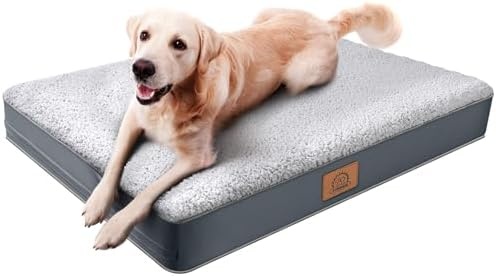
The removable-cover pick: Sunheir Washable Orthopedic Large Dog Bed with Removable Cover, Pet Bed Mat
 Visit on Amazon →
This is the simpler shape of the two, and simple is not an insult. It is a flat mat style bed in a large size class with an orthopedic build and a removable cover that comes off for washing. For a golden that sprawls flat and ignores bolsters, that is the correct geometry. Biscuit lies across the whole bed with his legs out, so a flat surface with a washable shell is exactly what he uses.
The removable cover is the part I care about most. A golden sheds, drools, and tracks in whatever is on the floor, and Maple's skin means her bedding goes through the machine regularly. A bed with a cover you cannot pull off is a bed you vacuum forever and eventually throw out. A cover you can pull off and wash is a bed that stays in service.
Check current Amazon price. Then check the listing for two things I cannot confirm from here: the stated foam depth in inches and the stated foam density. If the depth is three inches or more and the cover is genuinely machine washable, this is a sensible everyday bed for a large golden. If the depth is listed as two inches, walk away, because that is a mat and you already know what a mat does.
Flaws but not dealbreakers: A mat shape gives you nothing to lean against. If your golden likes to rest his chin on a raised edge, this is not that bed, and you should look at the sofa style below.
Anyone with a sprawler, a heavy shedder, or a dog with sensitive skin who needs a cover that goes in the wash without a fight should start here.
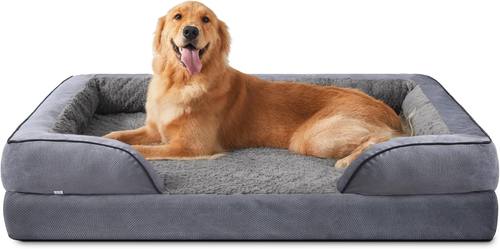
The structured sofa pick: INVENHO Orthopedic Dog Beds Large Sized, XL Washable Dog Sofa with Egg-Crate Foam, Waterproof Lining and Non-Skid Bottom
 Visit on Amazon →
This one is the more built out of the two. It is an XL washable dog sofa with egg-crate foam, a waterproof lining, and a non-skid bottom. The egg-crate profile is worth understanding, because it is not decoration. A convoluted foam surface spreads a heavy dog's weight over more contact points instead of letting the hips and elbows drive straight down into a flat slab, and the channels let air move under the dog. For a 95 pound golden, that distribution is the whole point of buying a bed instead of a bath mat.
The waterproof lining is the feature I would verify first. There is a real difference between a liner that keeps accidents and drool out of the foam core and a coating that peels off in the wash. The good version means you can wash the cover and the foam core never gets wet. The bad version means the foam core smells like a kennel within six months and no amount of washing the cover fixes it.
The non-skid bottom is the quiet win. On a tile floor or a hardwood hallway, a sliding bed is a bed a golden will not use twice. Check current Amazon price, then read the listing for the foam depth and density, and confirm the lining is described as a separate liner rather than a sprayed on treatment.
Flaws but not dealbreakers: A sofa shape takes up more floor space than a mat and costs more to ship, and the raised edges collect hair in the seams. If your golden is a pancake-and-sprawl sleeper, the flat bed above is the better match.
Anyone whose golden likes to curl against a bolster, or who needs waterproof protection under a washable cover, will get more out of this shape.
How to size a bed for a 95 pound golden
Sizing is where most owners get it wrong, and it is the cheapest mistake to avoid. Run these steps before you order anything.
Step one: measure the sprawl, not the curl. Wait until your golden is asleep and stretched out, then measure from the tip of the nose to the base of the tail. That is the number that matters. A curled up dog looks small. A sleeping golden takes up the whole hallway.
Step two: add the sprawl allowance. Add six to eight inches to that measurement. Dogs shift position through the night, and a bed that fits the curl exactly puts a hip or an elbow on the floor the moment they stretch.
Step three: match the size class to the number. Most large beds are sized for dogs in a weight range that overlaps with a golden, and XL sizes are aimed at the top of that range. A 95 pound Biscuit is at the top of the large range, so if your golden is 85 pounds or more, size up rather than down. A bed that is technically big enough but snug will get abandoned for the floor.
Step four: check the foam depth against the dog's weight. Three inches is the minimum for a golden, four is better. This is the step where a cheap bed reveals itself, because two inches of foam does not hold up a 90 pound dog, and you can feel it flatten the first week.
Step five: confirm the cover comes off and the bottom grips. Those two details decide whether the bed gets used and whether it survives the first year.
Step six: do the sink test when it arrives. Lie on the bed yourself, or press with a flat palm and a straight edge, and see how far the foam compresses. Write down the date and the number in a notebook. Then do it again in six months. Half an inch of loss over six months is normal. Two inches of loss over four months means you bought low density foam, and now you know for next time.
How to set up the bed so it lasts
Where the bed goes matters as much as which bed you buy. Put it on a flat surface, not over a floor vent and not in a doorway where it gets stepped on. If your golden is a senior or has trouble getting up, place it against a wall so he can brace his back against something.
Wash the cover before the first use, on the warmest setting the care label allows, and check the seams afterward. That first wash tells you what the next two years will look like. If the zipper jams or the lining separates on wash number one, you want to know that while the return window is open.
Keep a second cover or a spare flat mat in rotation if you can. The bed that gets washed on a Sunday morning and is still damp at bedtime is the bed that gets skipped, and a golden will pick the floor over a damp bed every time.
The competition and why it lost
Donut beds look cozy and photograph beautifully, and they are wrong for a golden. A 90 pound dog turns a donut into a pancake with a rim, and the foam under the middle collapses first because all the weight lands in one spot.
A $40 bed labeled orthopedic is not a cheaper version of a good bed. It is two inches of low density foam with a confident font on the box, and it will be a pancake in a season. If your budget is genuinely tight, buy a cheap flat mat for a puppy and upgrade at the one year mark, because puppies chew and grow out of sizes anyway.
Cooling gel beds can help in a hot summer, but the cheap ones burst, and a burst gel pad under a golden means a wet floor and a foam core that never dries properly. If you go that route, buy from a brand that will stand behind the liner.
Furhaven style budget beds are fine for what they are. You are buying about 18 months of use, not a bed you hand down. Nothing wrong with that if you go in knowing it.
And a note on the word premium. It means nothing on a dog bed. A premium label on a $39 product is a font choice, not a foam spec. Ask for inches and pounds per cubic foot, and let the adjectives go.
What this all costs
Cost per day is the only honest way to compare two beds. Take the price, divide by the days you expect to use it, and compare that number instead of the sticker.
A bed that lasts two years gives you about 730 days. A bed that lasts four months gives you about 120. Run the same money through both and the picture flips completely, because the cheap bed that dies in a season costs several times more per day than the bed that holds its shape. The expensive bed is usually the cheaper one. You just pay for it all at once.
The two beds here are the middle of the range, not the top. Check current Amazon price on both, add up the cost of a spare cover if you want one in rotation, and divide by 730. That is your real number. Compare it against the mat you were about to buy and the math will make the decision for you.
The rest is discipline. Measure the sprawl, insist on three inches of foam or more, confirm the cover comes off, run the sink test the day the box arrives, and write the number down. A golden retriever will spend most of his life on that bed. It is worth twenty minutes of homework to make sure it is still a bed next winter.