Most golden retriever owners buy their first bed the same way I did ten years ago. You walk into a pet store, see a big puffy rectangle with the word orthopedic stamped on the box, and hand over a card. Four months later the thing is a pancake, the dog is sleeping on the floor next to it, and you are shopping again.
Finding a real orthopedic dog bed for golden retrievers is not about brand names or the word premium. It comes down to three things you can check with your own hands: how thick the foam is, how dense it is, and whether the cover survives a wash cycle.
I have two goldens. Biscuit is 95 pounds and has destroyed gear I paid too much for. Maple is 60 pounds and has skin that reacts to everything. Between the two of them and the beds I have measured over the last decade, I have a notebook full of numbers that tell me which beds hold their shape and which ones are donations to the landfill.
Here is the short version: measure your dog, measure the foam, wash the cover before the return window closes, and run the cost-per-day math before you decide.
Why you should trust me
I spent eight years as a vet tech before I started writing full time. That job taught me to look at a large dog's hips and elbows as joints that will eventually be my patient, not as a cute feature. It also taught me that the difference between a bed a 95-pound dog can use and a bed that hurts him is measurable.
I keep a notebook. Every bed that comes into this house gets measured the day it arrives, again at three months, and again at six. Foam sink depth under my weight, thickness at the center and at the corners, and total weight before and after a wash cycle. I have filled a lot of pages.
I do not review food, medicine, or supplements. Beds, mats, crates, and sleep accessories are my scope, and that is where I stay.
How I picked and how I tested
Every bed in this guide gets the same four checks, and you can run all four yourself.
First, the sink test. I press into the sleeping surface with my knee, or lie on it if the store will let me, and measure how far the foam compresses under real weight. A bed that sinks four inches under a person is not supporting a 95-pound dog, it is just cushioning the floor.
Second, the wash test. A cover that cannot come off is a deal-breaker in this house. Maple has sensitive skin and Biscuit drools, so a bed gets washed every few weeks. I check the zipper, the seams, and the backing after the first wash, not after the tenth.
Third, the re-measure. I check thickness at month three and month six. Half an inch of loss is normal. An inch and a half means the foam is failing and the bed is on borrowed time.
Fourth, the cost-per-day math. Divide what you paid by the number of days the bed actually lasts. That number, not the sticker, is the real price.
What I cannot verify from a listing is how a specific foam core behaves in your house. So the two beds below are starting points, and the steps after them are how you confirm the choice yourself.
Two beds worth starting with
These are two different jobs. One is for the adult golden who sleeps eight hours a night in the same spot. The other is for the puppy months, when you should not be spending real money on anything that teeth can reach.
The big-dog pick: Bedsure SupportMax® Extra Thick Orthopedic XL Dog Bed for Extra Large Dogs
 Visit on Amazon →
This is the size class a golden actually needs. Extra large, built for extra large dogs, which puts it in the running before you even read the spec sheet. Most beds sold for goldens are really medium beds with a golden in the product photo, and a dog that weighs 95 pounds will hang off the edge of those.
When it arrives, do three things before you throw the box out. Measure the sleeping surface at the center, not at the bolster, because listed thickness often describes the raised rim rather than the part the dog lies on. Press your knee into the middle and watch how far it sinks. Then unzip the cover and wash it, because the return window is the only time you get to test the part that fails first.
Flaws but not dealbreakers: Thick foam takes longer to dry, so plan on a full day of air drying after a wash. Extra thick beds are also heavy and awkward to drag between rooms, and a senior golden who is already stiff may need a step or a thinner mat beside it rather than one tall bed.
Anyone with a full grown golden, or any dog in the 70-pound-and-up range, who wants the dog off the floor and off your mattress should start here.
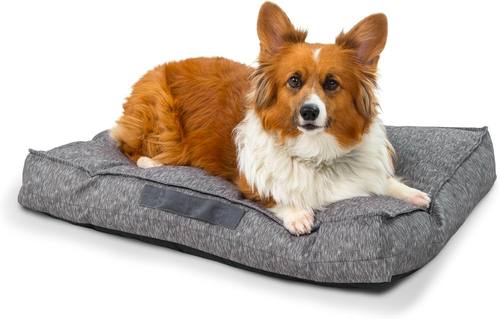
The puppy-stage pick: Best Friends by Sheri Dura-Tuff Durable Dog Bed, Gray, 30" x 20"
 Visit on Amazon →
I want to be straight with you about the size. Thirty by twenty inches is a small bed. A full grown golden will not fit on it, and any listing photo that puts a big dog on a bed this size is telling you a story. As a crate pad or a first bed for a puppy, though, the math changes completely.
You are not buying two years of use here. You are buying a washable, tougher surface for the window between three and nine months, when a golden puppy is chewing everything and having accidents. The Dura-Tuff name points at a more abrasion-resistant fabric than the plush covers on the cheapest beds, which is exactly what you want when teeth are involved. When your puppy outgrows it, you pass it to a foster, drop it in the car, or keep it as the travel bed.
Flaws but not dealbreakers: It will be outgrown, and probably faster than you expect. The small footprint also slides around inside a large crate, so put a non-slip mat underneath or tuck it against a crate wall.
Puppy owners, foster homes, and anyone who wants a second bed for the car or the vet visits should buy this one and save the serious money for the adult bed.
How to measure a bed before you buy it
This is the part most owners skip, and it is the reason so many beds end up in the garage.
Step one: measure the dog, not the breed. Goldens vary a lot. Biscuit takes up 52 inches when he sprawls out flat, which is why a bed listed at 40 inches is a non-starter for him. Measure your own dog from nose to tail while he is stretched out and asleep, then add about six inches. If you cannot measure him asleep, measure him standing and add a foot.
Step two: measure elbow to floor. For a large dog this is roughly eight to ten inches. The point of an orthopedic bed is that the elbow and hip never contact the floor through the foam. If a bed compresses to two inches under body weight, the joints are on the ground with a blanket over them.
Step three: run the sink test. Lie on the bed, or press down hard with your knee, and put a ruler against the side to see how far the surface drops. A bed that bottoms out under you will bottom out under your dog. Do this in the store if you can, and at home within the return window if you cannot.
Step four: ask for foam density. Three to four pounds per cubic foot is real orthopedic foam. One and a half to two pounds is a scam with good photography. Most listings do not publish this number. Ask the seller directly. If they will not answer, that silence is your answer.
Step five: find the zipper. If the cover does not unzip, you cannot wash the whole bed, and an unwashed bed grows a smell that no amount of baking soda fixes. No zipper, no sale.
Step six: wash it early. Run the cover through a cold cycle in the first week, while you can still return it. If the waterproof backing cracks, the fabric pills, or the seams pull, send it back. This is the failure that kills beds quietly.
Step seven: add a liner. A cheap waterproof liner under the foam core protects the expensive part from accidents and drool. Replace the liner, not the bed.
Step eight: write it down. Date, thickness, and a note about the first wash. Re-measure at three months and six months. Half an inch of loss is normal wear. An inch and a half means start shopping again, and start the warranty conversation.
What the marketing words actually mean
Orthopedic has no legal definition for pet products. It means the foam is thick enough to be called thick. Ignore it and look for density.
Extra thick usually describes the tallest point of the bed, which is often the bolster. Ask for the sleeping surface measurement instead.
Waterproof almost always means a coating, and coatings delaminate. A removable, washable liner is worth more than the word on the box.
Premium is a word that costs the manufacturer nothing and costs you money.
Cooling gel beds can genuinely help in a Colorado summer, but the cheap ones burst, and a burst gel pad means a ruined floor and a trip to the vet to check for ingestion. Buy the feature from a brand that will stand behind it, or skip it.
Memory foam is not automatically good. Low density memory foam flattens faster than decent conventional foam. Density first, marketing second.
The competition and why it lost
Donut beds are for small dogs. A 90-pound golden turns one into a pancake with a rim, and then he sleeps next to it.
Two-inch orthopedic mats are mats. They are fine for a crate pad in a car and useless as a primary bed for a large dog.
Cedar-filled and shredded-foam beds feel great for about six weeks, then they clump into lumps and you are rearranging stuffing every night.
Any bed with a sewn-shut cover is out of the running in this house, no matter how good the foam is.
The genuinely expensive orthopedic tier, the ones that run into the hundreds, is real. I have paid it, and I would again, because the foam holds up and the warranty gets honored. But you should reach that tier because the math supports it, not because a photo of a sleeping golden made you feel something.
What this all costs
Cost per day is the only honest comparison. Divide the price by the number of days the bed actually lasts. A bed that survives four years and a bed that dies in four months can sit on the same shelf looking equally puffy. Do the division and the cheap one stops looking cheap.
There are three ways to move that number in your favor. Buy a bed with a washable cover so the foam core never gets soaked. Add a waterproof liner so accidents hit the liner instead of the foam. And repair what is repairable: a new zipper or a patched cover seam is a fraction of the price of a replacement bed, and a good foam core deserves the repair.
For a golden, the goal is simple. One bed that fits a stretched-out 95-pound dog, holds its shape past year two, and goes in the washing machine. Measure first, wash early, and do the division. That is the whole job, and your dog's hips will thank you for doing it.