Most golden retriever beds fail in the same three places. The foam collapses under a 90 pound dog, the zipper splits the first time you wrestle the cover off, or the fabric turns into a sponge that never dries. A good golden retriever dog bed is not the one with the loudest orthopedic label on the box. It is the one that is still holding its shape two winters from now.
I own two goldens. Biscuit is 95 pounds, six years old, and destroys things for sport until he decides a bed is officially his base of operations. Maple is 60 pounds, three years old, and has sensitive skin, so her covers get washed twice as often as his. Between the two of them I find out fast which beds are real and which are a donation to the landfill.
Ten minutes of measuring before you buy beats a year of watching a bed turn into a pancake. Here is the process I use.
Why you should trust me
I spent eight years as a vet tech before I started writing about this full time, which means I saw the other end of bad bedding. Senior goldens with elbows that never got a break, hips that stiffened because the foam under them bottomed out every night. I am not a veterinarian and I do not play one online. What I can tell you is what a large dog's joints actually need underneath them, and what a spec sheet has to prove before I believe a word of the marketing.
I have tested more than 60 dog beds in ten years and I keep a notebook with real dates in it. Foam sink depth on arrival, foam sink depth six months later, cover weight before and after a wash cycle, zipper condition. When a bed flattens, I have a number for it, not a feeling. That is the difference between a review and an advertisement.
How I picked and how I tested
Two beds made this short list, and they solve two different problems.
The first is a washable orthopedic bed in XL built for senior dogs. That is the bed I want under a golden who has started taking longer to stand up in the morning, because the whole point of an orthopedic bed is foam that does not bottom out under body weight. The second is an armored crate pad built for a dog that chews. That one lives in the crate, not on the living room floor, and it exists because some goldens treat a foam pad like a stuffed toy.
Every bed that comes into this house goes through the same checklist before it earns a spot:
- I lay the bed flat and measure the loft of the sleeping surface with a tape, not with my palm. If a listing calls a bed orthopedic and the foam is thin, the math does not work no matter how nice the cover feels.
- I do the sink test. I lie on the bed myself and measure how far the surface compresses under my weight. Foam that bottoms out under me will bottom out harder under Biscuit.
- I check the cover for a real zipper and a washable fabric. If the cover cannot come off and go in the machine, the bed is finished the first time a golden has an accident on it.
- I check the base. A bed that slides across a hardwood floor gets abandoned, because no dog wants to climb onto something that skates away from them.
- I measure the dog, not the bed. A golden stretched out flat needs more length than the product photo suggests.
I do not trust a bed because the box says premium. I trust it because the cover comes off, the foam has body, and the base stays put.
The two beds I would start with
One for the floor, one for the crate. That is the entire setup for most golden households.
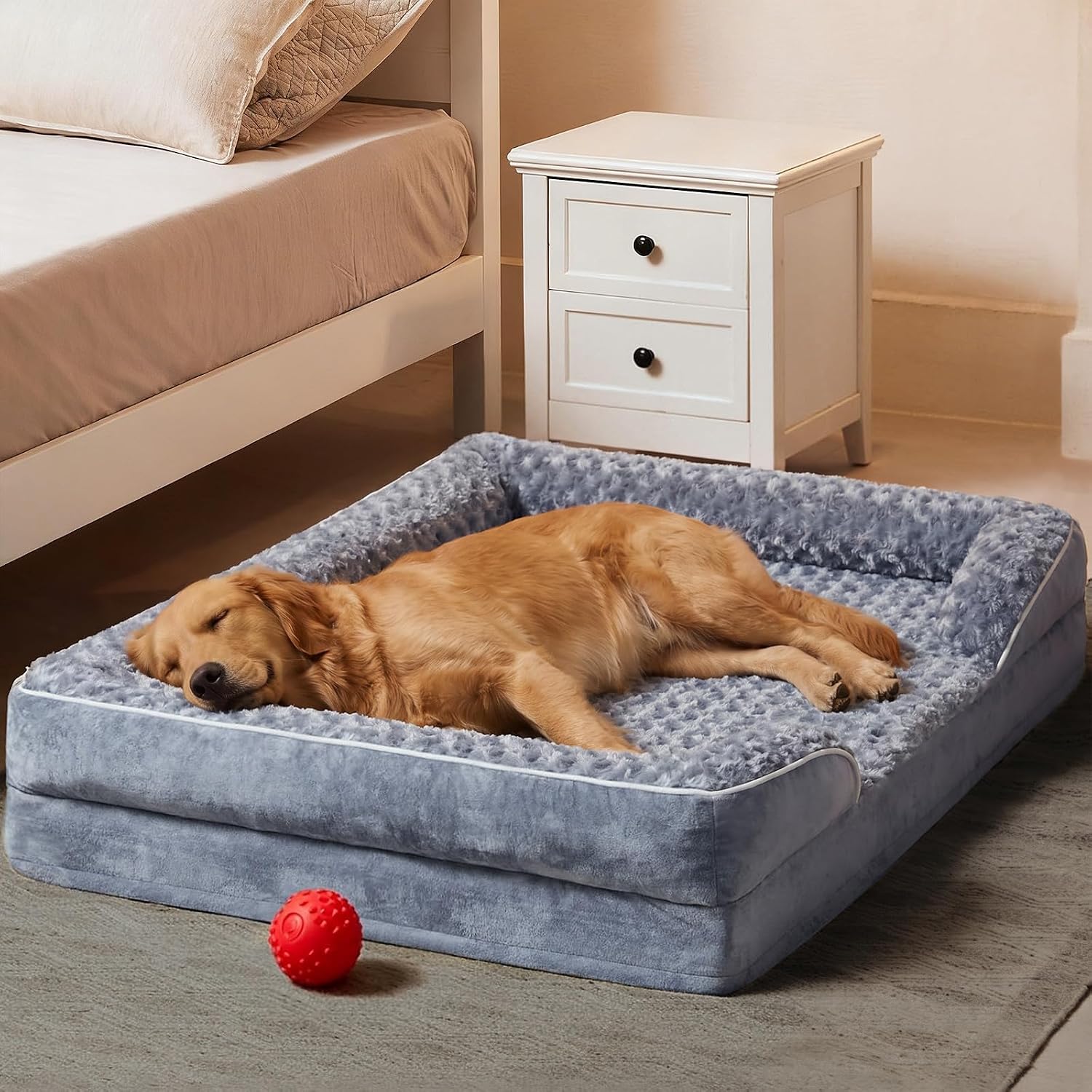
Budget pick: WNPETHOME Orthopedic Washable XL Dog Bed for Senior Dog Cozy Sleep
 Visit on Amazon →
This is the bed I point senior owners toward when they want support without paying boutique money. The XL sizing is the important part for a golden. Maple can curl up on a medium without complaint, but Biscuit does not curl. He sprawls, and a sprawled golden needs length. The washable cover is the feature I care about most, because an XL floor bed is the one that gets used every single night and picks up everything.
Flaws but not dealbreakers: orthopedic on a bed in this price bracket is a claim you have to verify yourself. Do the sink test on day one and write the number in a notebook. If it bottoms out under your own body weight, send it back while the return window is open. That is not a knock on this bed specifically. It is how I treat every bed at this price, and it is why I keep measurements instead of opinions.
Anyone whose golden has started moving slower in the morning, and who wants a machine washable cover without a huge budget, should look here first.
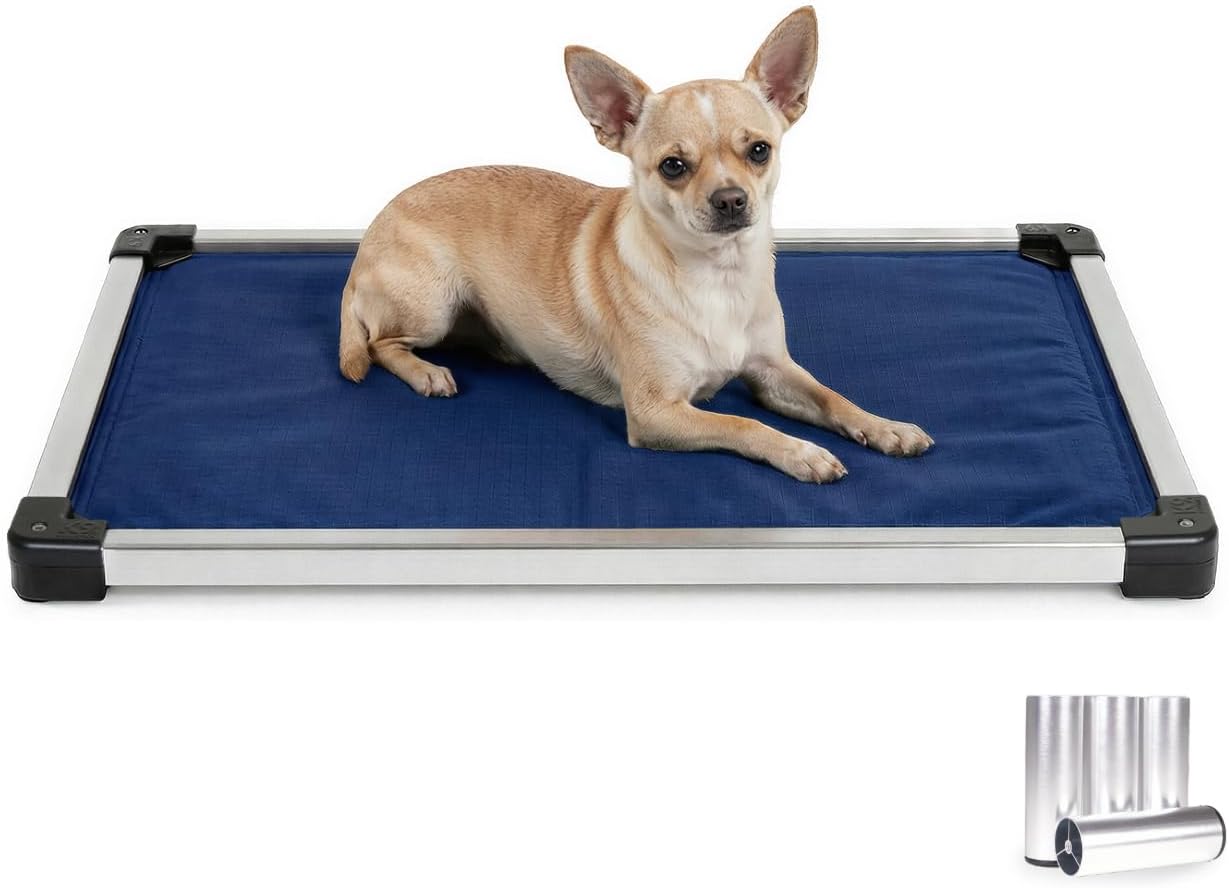
Chew-proof pick: K9 Chew Proof Armored Padded Dog Crate Bed, S, Blue Quartz
 Visit on Amazon →
This is the crate pad for the golden who has already destroyed something soft. The armored construction is the entire point. A standard crate pad is foam wrapped in fabric, which means one determined dog can open a seam in an afternoon and then eat the foam. A bed with a reinforced chew resistant outer shell is playing a different game.
Size is the thing to get right here. The size S is a small pad, so measure the interior of your crate and match it against the size chart before you order. A pad that does not fill the crate floor leaves a gap, and a gap is where a bored golden starts working on the tray instead.
Flaws but not dealbreakers: armored fabric is stiffer than plush fleece, so a dog used to a soft bed may take a week to settle on it. Put something familiar in the crate for the first few nights and the transition is usually short.
Anyone with a chewer, a puppy in the destructive stage, or a dog who has to be crated while you are out should start here rather than replacing a soft pad every other month.
The buying workflow, step by step
Now the part you came for. Run these in order and you will not buy the same bed twice.
Step one: measure your dog lying down. Not standing, not sitting. Get your golden flat on the floor, stretched out the way they actually sleep, and measure nose to tail and shoulder to shoulder. Add a few inches on every side. That is your minimum bed size, and it is usually bigger than the bed you were about to order.
Step two: decide floor bed or crate bed. These are two different products with two different jobs. A floor bed needs support and a washable cover. A crate bed needs to fit the crate and survive teeth. Buying one bed to do both jobs is how people end up with a shredded orthopedic bed sitting in a crate.
Step three: check the foam claim against the foam reality. Read the listing for thickness and density, then do the sink test when the box arrives. If the listing brags about orthopedic support and the foam gives way the moment you press with your palm, you have a mat with big letters on the box.
Step four: confirm the cover is machine washable. This one is a dealbreaker for me. Look for a cover that unzips completely, not one with a small opening you have to fight the foam through. Maple's skin means her beds get washed often, and a cover that only half comes off is a cover that never gets clean.
Step five: check the base for grip. Flip the bed over. If the bottom is smooth nylon it will slide on hardwood and your golden will choose the floor instead. A textured or rubberized base is worth more than any bolster.
Step six: set a replacement date. Put the purchase date in your phone and check the bed in six months. Measure the sink again. If the sleeping surface has flattened noticeably, the bed is done, regardless of what a warranty says.
Step seven: wash it before the dog ever uses it. New beds carry manufacturing residue and a smell. One wash cycle before the first night removes both, and it tells you immediately whether the cover survives laundering.
Mistakes that cost goldens their sleep
The most common one is buying a bed for the photo instead of the dog. A picture of a curled up spaniel on a bed marketed for large dogs tells you nothing about whether a 95 pound golden will fit on it.
The second is trusting the word orthopedic. A thin layer of cheap foam is not orthopedic, it is a mat with big letters on the box. Foam that compresses to the floor under your own body weight does nothing for a dog's elbow.
The third is skipping the cover question. A waterproof cover that delaminates after one wash is worse than no waterproofing at all, because now you own a bed with a cracked coating that traps odor. If you cannot wash it, do not buy it.
The fourth is buying cheap for a puppy and forgetting to upgrade. For a puppy, cheap is correct, because they will destroy it and grow out of it. For a six year old golden, cheap is a delay tactic.
What this all costs
Do not compare sticker prices. Compare cost per day. Take the price on the listing, divide it by the number of days you expect the bed to last, and compare that number against the alternative. Divide any price by 730 days and it gets very small very fast.
The math changes the whole decision. A cheap bed that flattens in four months and gets replaced three times in two years costs more per day than a good bed bought once. It just does not feel that way at checkout.
For most golden households the split I recommend is one supportive floor bed and one armored crate pad. Buy the floor bed for the joints and the crate pad for the teeth, and you stop replacing both every season.
A question I get every week
Does a young golden need an orthopedic bed? No. A healthy three year old needs a bed that fits and a cover you can wash. Save the orthopedic money for the years when the joints actually need it, and spend the difference now on a bed that will still be here when they do.
The bottom line
Measure the dog, do the sink test, check the zipper, and put a replacement date on your calendar. That is the whole system, and it works on any bed at any price.
Your golden sleeps somewhere between twelve and fourteen hours a day. That is a lot of hours on foam that either holds up or does not.