
Most people shop for an orthopedic dog bed for a golden retriever by reading the box. That is the wrong order. The box tells you what the brand wants you to believe. Your dog tells you what he actually needs, and he does it with weight, length, and the way he lies down.
I spent eight years as a vet tech before I started writing about dog beds full time, and I have two goldens of my own. Biscuit is 95 pounds, six years old, and destroys things for sport. Maple is 60 pounds, three years old, and has sensitive skin, so she needs a cover I can wash every week. Between the two of them, I have watched enough foam fail to stop trusting adjectives.
This is the process I use before I spend money. You will measure your dog, learn what the word orthopedic is allowed to mean, and decide between a floor bed and a crate pad. No marketing words required.
Why you should trust me
I have tested more than 60 dog beds over ten years and kept a notebook the whole time. Real dates, real numbers, real sink depth measured with a ruler. I have watched cheap foam flatten in four months, and I have watched a properly dense bed hold its shape for two years with a 95 pound dog on it every night. I also know what a failed zipper looks like on day 40, because I have replaced enough of them.
I am not a veterinarian and I will not give medical advice. If your golden is limping or has a diagnosed joint problem, call your vet. What I can do is tell you what foam does under weight, and how to check it yourself.
What "orthopedic" is allowed to mean
Orthopedic means the foam supports a large dog's joints instead of letting them sink to the floor. That is a physical property, and physical properties can be measured.
The number that matters is foam density, in pounds per cubic foot. Three to four pounds per cubic foot is real support foam. One and a half to two pounds is a scam with a nice label. A two inch slab of anything is not orthopedic. It is a mat. I do not care what font the box uses.
For a golden, you also want thickness you can verify. Lie on the bed yourself. Put your hand under the foam and feel how far your weight travels. If your hips reach the floor, so will your dog's.
Marketing words like premium, deluxe, and waterproof mean nothing until the spec sheet or your own ruler proves them. Waterproof is the one that fails most often, usually after the first wash, when the coating separates from the fabric and the cover starts flaking.
Measure before you buy: the four numbers you need
Step one: length. Measure your golden from the front of the chest to the base of the tail, then add 8 to 12 inches. A dog who sprawls needs the bigger number.
Step two: width. Measure across the shoulders and add a few inches. Goldens often sleep on their sides with legs extended, so the bed should be wider than the dog is tall.
Step three: weight. Know the actual number. A 95 pound dog and a 60 pound dog do not need the same foam.
Step four: sleep style. Watch where your dog lands at night. A curler wants a bed with a low rim. A sprawler wants a flat, wide surface and will ignore the bolster you paid extra for.
Write those four numbers down before you open a shopping app. They eliminate half the listings on their own.
Two beds that fit the criteria
These are the two configurations I would start with for a golden, one for the floor and one for the crate. Both are here because their specs match the checklist above, not because of a slogan.
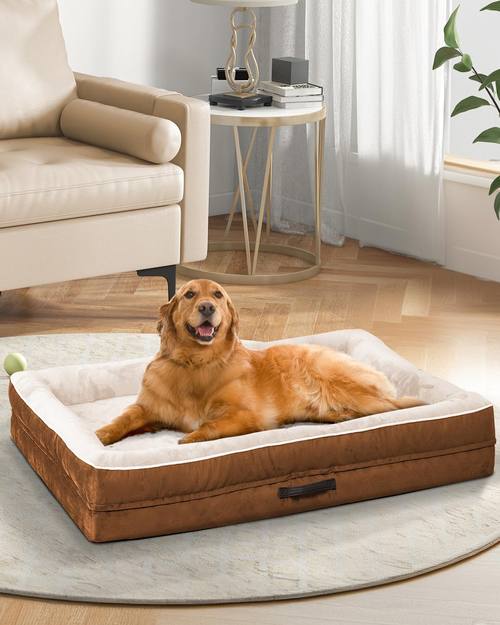
Budget-friendly pick: Upvilla Orthopedic Dog Bed XL, Four-Sided Dog Sofa, Washable Cover, Brown
 Visit on Amazon →
This is the XL four-sided sofa shape, and the four sides matter for a golden who likes to rest his head. The XL footprint gives a sprawler room to stretch without hanging off the edge. The cover is washable, which is my first dealbreaker, because a golden in Colorado brings in mud, pollen, and at least one mystery stain per season.
Check the foam thickness against the sink test before you commit. The four-sided design also gives you a backrest for leaning, which is the part of a sofa bed that actually helps an older dog get up.
Check current Amazon price. Confirm the XL dimensions against your four numbers.
Flaws but not dealbreakers: A four-sided bed with a rim is harder to wash than a flat mat because the cover has more seams. Follow the wash instructions and air dry it. Do not put it in a hot dryer.
Anyone who wants a floor bed for a golden who curls against a side will do well here.
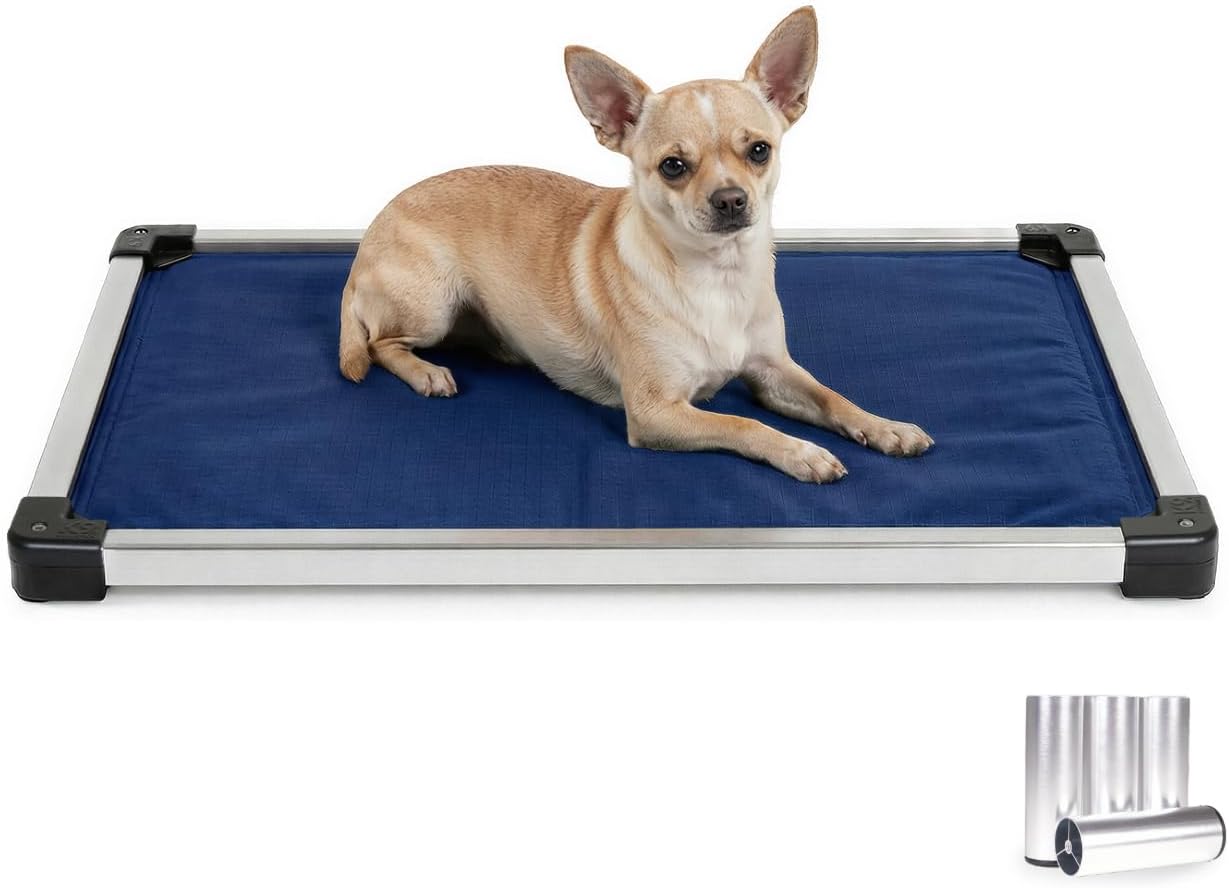
Chew-proof pick: K9 Chew Proof Armored Padded Dog Crate Bed, S, Blue Quartz
 Visit on Amazon →
Biscuit has destroyed beds that cost more than my first car, so I pay attention to anything with armor in the name. This crate bed uses a chew proof armored build with a padded sleep surface, which is the combination you want for a dog who treats fabric like a puzzle.
One honest caveat: this listing is a size S. A full grown golden needs a crate pad sized to his crate, so check the size chart and order the largest option that fits your crate before you buy. For a puppy in a small crate, or for a golden who sleeps in a travel crate, the S is the right call.
Check current Amazon price. Measure your crate's interior before ordering.
Flaws but not dealbreakers: Armored fabrics are tougher and less breathable than plain fleece. If your golden runs hot, put a thin washable topper over the pad.
Anyone with a chewer, a puppy, or a dog who spends nights in a crate should start here.
How to run the sink test
The sink test is simple. Put the bed on the floor, lie on it, and measure how far the foam compresses under your weight. You are looking for support that pushes back, not a surface that swallows you.
In a store, press your palm into the center of the bed and count how long the foam takes to spring back. Slow recovery and a deep dent mean low density. If you can feel the floor through the foam with your hand, a 95 pound golden will feel it with his elbows.
At home, use a ruler. Mark the starting height of the foam, lie down for one minute, and measure again. Do the same test six months later. Cheap foam loses height, and the change shows up in the notebook before it shows up in your dog's gait.
One caveat: your weight is not your dog's weight, and your dog's weight is not distributed the same way. Use the sink test as a comparison between beds, not as a diagnosis.
Cover, zipper, and the wash routine
A machine washable cover is a dealbreaker for me. If I cannot wash it, I will not buy it, because a golden's bed collects more dirt than any other piece of furniture in the house.
Check the zipper before anything else. A plastic zipper with fine teeth will fail. A metal zipper with a decent pull will survive. Look at the seam where the zipper meets the cover, because that is where the tear starts.
Wash cold, on a gentle cycle, with the cover zipped shut. Air dry it. Heat is what kills the coating on a waterproof cover and shrinks the fabric.
If the cover fails before the foam does, price a replacement cover before you replace the whole bed. A repairable bed is a cheaper bed.
Crate size and the puppy problem
For a puppy, buy cheap and upgrade later. Puppies chew, leak, and grow. Spending big on a bed for a 20 pound puppy is a waste, because that dog will be 60 pounds by winter.
For a full grown golden, size the crate pad to the crate, not to the dog's curled-up footprint. The pad should cover the floor with no gaps at the corners, because a gap is where a chewer starts digging.
If your golden is a senior, a thicker pad plus a low entry helps. If he is a chewer, armor matters more than plush.
Cost per day, not sticker price
Sticker price is what marketing wants you to look at. Divide the price by the days you expect the bed to last. That is the only honest comparison.
A bed that costs two hundred and fifty dollars and holds its shape for four years costs about seventeen cents a day. A forty dollar bed that flattens in four months costs about thirty-three cents a day, and you buy it five more times. The expensive bed is the cheaper one. You just pay for it all at once.
For a golden, I would rather see you spend once on dense foam and a washable cover than replace a pancake every season.
Mistakes I see in golden groups every week
The first mistake is believing a two inch orthopedic mat will support a 90 pound dog. It will not.
The second is buying a donut bed for a large dog. A golden turns a donut into a pancake with a rim.
The third is trusting a product photo with a tiny dog on a bed marketed for large breeds. Check the dimensions, not the picture.
The fourth is a waterproof cover that delaminates after one wash. If the listing does not explain how the cover is waterproof, assume it is not.
The fifth is skipping the warranty question. A brand that honors a warranty is a brand that expects the bed to last.
The short version
Measure your golden, add room to sprawl, and write the numbers down. Demand real foam density and thickness you can verify. Insist on a washable cover and a zipper that will survive it. Then divide the price by the days you expect to get, and buy the bed that wins that math.
Your golden sleeps fourteen hours a day. The bed is not a splurge. It is the piece of furniture he uses most.