
Most orthopedic dog beds are a lie told with big letters on the box. If you are shopping for an orthopedic dog bed for senior goldens, the first thing to accept is that your dog does not lie on top of foam. A 95 pound golden sinks into it, and foam that sinks and never springs back is a pancake with a zipper.
I have two goldens. Biscuit is 95 pounds, six years old, and treats every bed like a chew toy with a deadline. Maple is 60 pounds, three years old, and has skin that reacts to whatever detergent a factory leaves in a cover. Between the two of them I have learned that the bed you buy for a senior golden is a different product from the bed you buy for a puppy, and the difference is measured in inches, foam density, and how many wash cycles the cover survives.
This is the process I use. No marketing words, just a ruler, a scale, and a notebook.
Why you should trust me
I spent eight years as a vet tech before I started writing about dog beds full time, and I have tested more than 60 beds over ten years, most of them with a ruler and a kitchen scale. I keep a notebook with real dates and real numbers: foam sink depth on arrival, sink depth six months later, cover weight before and after washing, days until the first seam failure. I have watched cheap memory foam flatten in four months and I have watched good foam hold its shape for two years.
I do not take money to change a review, and if a brand sends me something, I say so in the post. I was a vet tech, not a nutritionist, so I stay in my lane: beds, mats, crates, sleep accessories. Joint problems are a conversation for your vet, not for a product page.
How I picked and how I tested
The two beds below are not competing for the same job, which is why I put both in one article. One is a sleeping surface for a senior golden. The other is a crate bed for a dog that destroys things. If you have owned a golden for more than a year you already know you may need both at the same time.
Here is the framework I use on every bed, and the numbers I trust. Foam density in pounds per cubic foot: 3 to 4 is good, 1.5 to 2 is a scam with a nice photo. Thickness: 4 inches minimum for a dog over 80 pounds, and anything listed as orthopedic at 2 inches is a mat, full stop. Cover: removable and machine washable, with a zipper I can open without pliers. Sink test: kneel on the bed and measure how far the foam compresses under load. If it sinks more than half its thickness under a person, it will pancake under a 95 pound golden.
Then there is the wash test. I pull the cover, run it cold, and weigh it before and after. A waterproof backing that delaminates in one cycle is not waterproof, it is a coating with a marketing budget. Maple's skin tells me within a week whether a cover rinses clean.
Measure first: the numbers you need before you buy anything
Do this part in the room where the bed will live. It takes ten minutes and it saves you a return.
Step one: weigh your dog. A bed for a 60 pound dog and a bed for a 95 pound dog are not the same product, even when the listing shows one photo of one golden. Weigh your dog at the vet or stand on a bathroom scale holding your dog and subtract your own weight. Write it down.
Step two: measure nose to tail. Add 8 to 10 inches. A golden that has to curl into a ball to fit is not resting, it is enduring. Senior dogs with sore hips need room to stretch out flat, and they will not tell you the bed is too small. They will just sleep on the floor next to it.
Step three: measure the crate pan if the bed is going in a crate. Measure inside the lip, corner to corner, both directions. A crate bed that is a half inch too wide does not fit, no matter what the size chart says.
Step four: get the foam spec. Thickness in inches and density in pounds per cubic foot. If a listing will not tell you, that is your answer. The word orthopedic on a box proves nothing. A spec sheet proves it.
Step five: read the cover care tag. Machine washable and removable are two separate claims. You want both. If the waterproof liner is sewn in rather than zipped out, the cover gets heavy in the wash and takes two days to dry.
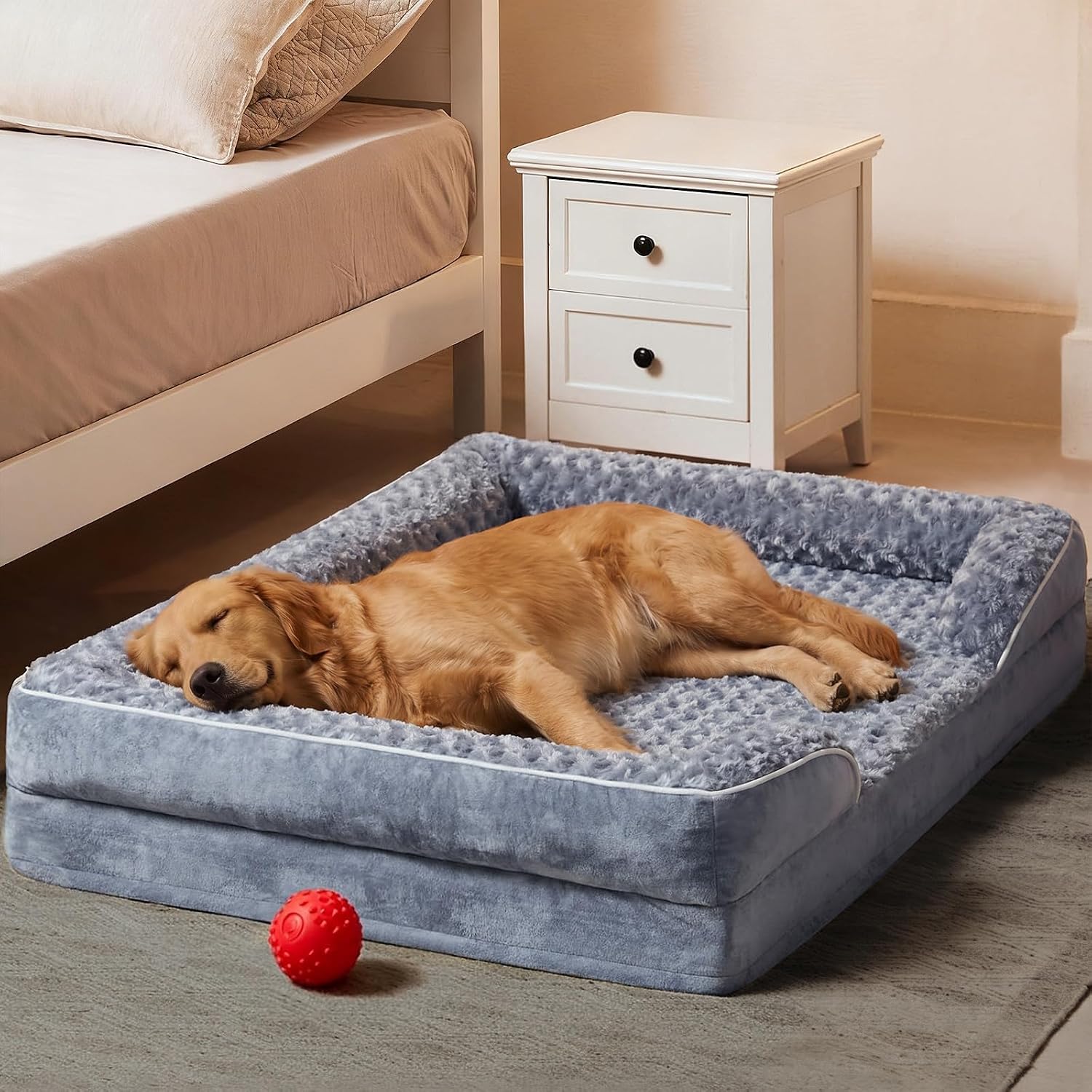
The bedroom bed: WNPETHOME Orthopedic Washable XL Dog Bed for Senior Dog Cozy Sleep
 Visit on Amazon →
This is where I would start for a senior golden, because the three words in the name are the three things that actually matter. XL is the footprint a 95 pound dog needs. Washable is the deal breaker in my house, because a cover that cannot go in the machine is a cover that smells like wet dog by February. And senior dog matters because older goldens spend 14 to 18 hours a day lying down, which is where a real slab of foam earns its keep and a thin pad gives out.
Before you order, check two things on the spec sheet: the foam thickness and the density. Anything under 3 inches bottoms out under a golden's hips, and the sink test will show it in the first week. Then check how the cover attaches. A zipper you can work with cold hands after a muddy walk is worth more than any feature with a trademark symbol next to it.
Flaws but not dealbreakers: No bed with a soft fabric cover survives a determined chewer. If Biscuit decides this is his base of operations and also his afternoon project, the cover loses. This is a sleep bed, not an armored bed.
Check current Amazon price, then do the division: price divided by the days it lasts. That is the only honest number in this category.
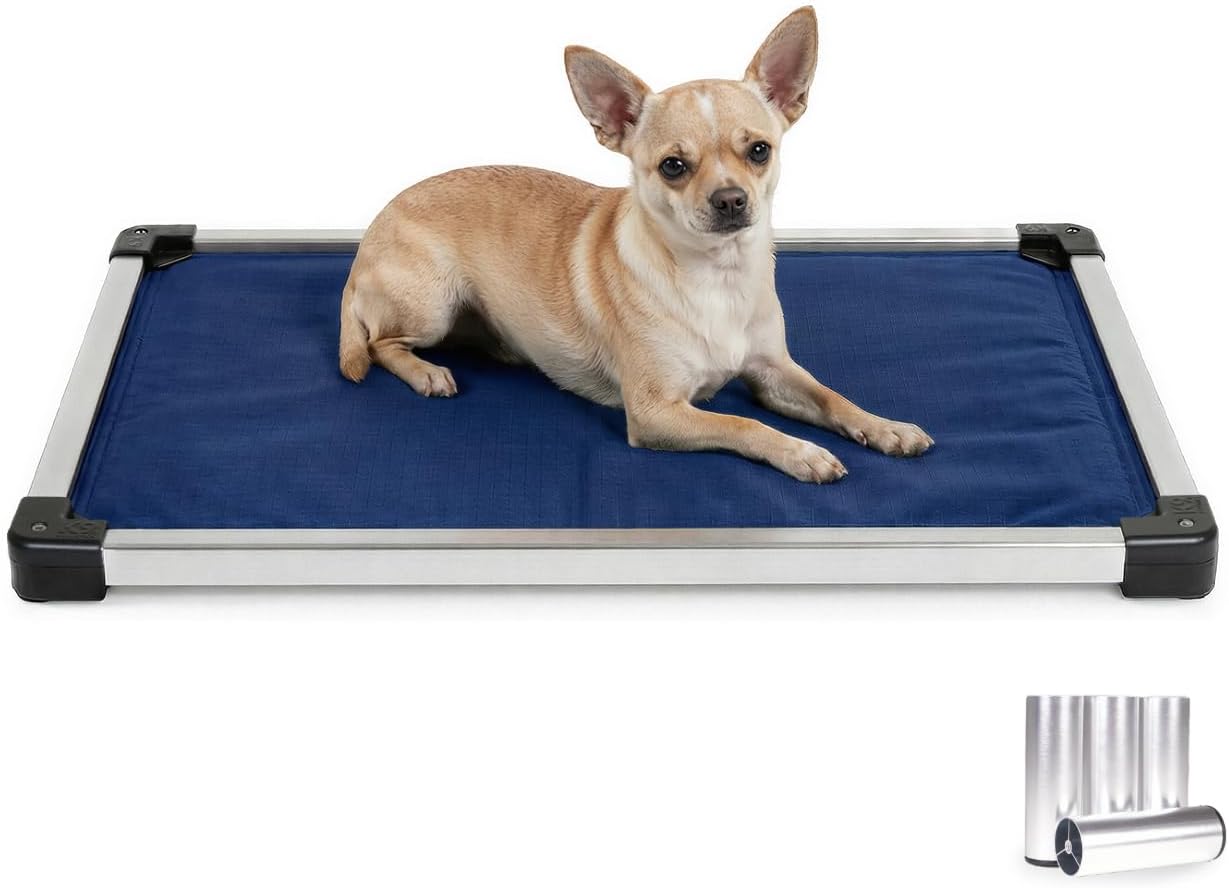
The crate bed: K9 Chew Proof Armored Padded Dog Crate Bed, S, Blue Quartz
 Visit on Amazon →
This one does a completely different job. Chew proof armored means the surface is built for a dog that eats beds, and padded means it is not a bare crate pan. The listing here is the small size in Blue Quartz, so read this carefully: that is a crate bed for a golden puppy or a smaller dog, not the main sleeping surface for a full grown male golden. Do not buy this size for a 95 pound dog and then blame the bed.
Where it earns its place is crate training and the destruction phase. A chewer does not get memory foam until the chewing stops. The armored surface means you are not buying a replacement every six weeks, and for a golden puppy that is the difference between one purchase and four. If your golden is crated while you are at work, this is the pad that survives the shift.
What to verify: measure your crate pan before ordering, corner to corner. Then look at how thick the padding is. Armored beds run thin by design, and a thin pad over a hard pan is fine for a puppy's joints for a few months. It is not the right surface for a six year old golden with an old elbow injury, because there is no give in it.
Flaws but not dealbreakers: Chew proof materials are usually not as soft and not as breathable as fabric, and they hold heat. In a Colorado July, a dog on an armored bed will go looking for the tile floor. Check current Amazon price and treat it as crate gear, not as furniture.
The setup workflow
Buying the bed is half the job. Here is what I do when a new bed comes through the door.
Let the foam breathe. Vacuum packed foam needs 24 to 48 hours to reach full loft. Unpack it, lay it flat in a warm room, and leave it alone. If you judge the thickness in the first hour, you are judging a compressed brick.
Run the sink test yourself. Kneel or sit on the bed and watch how far the foam compresses. A bed that sinks more than half its thickness under a person is going to flatten under a 95 pound dog that stands up and flops down eight times a day.
Place it where your dog already sleeps. Do not decide for your golden where the bed should go. Watch for a week. The spot they choose is the spot that gets used, and it is usually not the spot you picked.
Wash the cover before first use. Factory residue and packing dust come out in one cold cycle. Maple's skin reacts to detergent, so I use a fragrance free detergent and skip fabric softener entirely. Softener coats the fibers and kills breathability.
Wash every two to three weeks, vacuum the foam. The cover goes in the machine. The foam gets vacuumed with the upholstery attachment and left to air in the shade, never in direct sun, because UV breaks foam down. This is the single step most owners skip and it is why their bed smells.
Flip or rotate the foam monthly. A golden lies in the same spot every night. Rotating the foam spreads the compression and buys you months.
Re-measure at six months with a ruler. Same spot, same test. If the sink depth has doubled, the foam is done and no amount of cover washing will bring it back. That is your data point for whether you buy the same brand again.
Log it. Date, brand, thickness, sink depth, wash count. Two years of entries and you will never be fooled by a product page again.
What this costs
Here is the math that ends the argument about expensive beds. Take whatever you pay and divide it by the days the bed actually lasts. A bed that holds its shape for two years is 730 days of use. A bed that flattens in four months is 120 days. When you do that division, the cheap bed is often the more expensive one, and you paid for it in the annoying way: twice, plus a trip to the store.
Cost per day is the only honest price comparison in this category. Sticker price is what marketing wants you to look at. And there is a second cost most owners forget: the vet bill for a dog that has been sleeping on the floor because the bed pancaked in month three.
The mistakes I see most
Two inch foam sold as orthopedic. That is not a bed for a golden, that is a mat with big letters on the box.
Donut beds for large dogs. A 90 pound golden turns a donut bed into a pancake with a rim. Those are for small dogs, and the product photos usually prove it if you look at the dog in the picture.
Buying for the puppy you have instead of the dog you will get. A golden puppy at 25 pounds will be 80 pounds in a year. Buy the crate pad now and the real bed when the chewing stops.
Waterproof covers that delaminate after one wash. If the liner flakes off, it was never waterproof, it was coated.
Skipping the washable cover because it costs more. Can't wash it, won't buy it. That is a rule, not a preference.
The bottom line
For a senior golden, buy the largest washable orthopedic bed you can fit in the room, check the foam spec instead of the marketing words, and put an armored crate pad in the crate for the dog that destroys things. Those are two different purchases and they solve two different problems.
Then do the boring part: measure your dog, wash the cover on a schedule, rotate the foam, and write down what happens at six months. The bed that still has 4 inches of loft after two years of a 95 pound golden is the one worth buying again. Everything else was a rental.