
Most orthopedic dog beds for a golden retriever are two inches of foam with a confident label. I know, because I have opened enough of them. I spent eight years as a vet tech, I have owned two goldens, Biscuit at 95 pounds and Maple at 60, and I have kept a notebook on every bed that has come through this house for the last ten years. The notebook is boring. It is also the only reason I can tell you which beds flatten in four months and which ones still hold their shape two years in.
An orthopedic dog bed for a golden retriever is furniture, not an accessory. Treat the purchase like that and you spend once instead of three times. This is how I choose one, how I size it, how I set it up, and how I do the math that actually matters.
Why you should trust me
I was a vet tech for eight years before I started writing about gear full time, and I have had a golden retriever in the house for a decade. Two of them now, which means two very different sleeping styles on the same floor. I have put more than 60 beds through this house, and I keep a notebook with real dates and real numbers: foam sink depth on arrival, at 90 days, at six months, plus the weight of every cover after a wash cycle.
I buy most of what I write about. When a brand sends something, I say so in the post. No brand has ever paid me to change a verdict, because the answer is no. What I care about is measurable: does the foam come back, does the zipper survive, does the cover still fit after the fourth wash.
What the word orthopedic has to prove
A golden retriever carries 60 to 95 pounds on hips and elbows that were never designed for a lifetime of hardwood floors and tile. As a vet tech I saw plenty of large breed hips on an X-ray, and the dogs who did best were the ones whose owners thought about joint support years before anything hurt. A bed is not medicine. It is one of the few pieces of gear that touches those joints for eight hours a day, so it is worth getting right.
Here is the spec sheet version, not the marketing version.
Foam density. Three to four pounds per cubic foot holds up under a big dog. One and a half to two pounds per cubic foot is a mattress pad with ambition. Density is the number brands hide, and it is the number that decides whether your bed is a bed at 18 months or a pancake.
Thickness. Four inches is the floor for a dog in this weight class. Three inches is acceptable in a smaller bed for a smaller dog. Two inches is not orthopedic, it is a mat with big letters on the box.
Cover. Machine washable, and the zipper has to survive the machine. That is a deal breaker in this house. Can't wash it, won't buy it.
Waterproof. Real waterproof covers breathe and last. Cheap ones delaminate after one wash and leave you with a plastic sheet peeling off the fabric. I have thrown away more of those than I want to count.
The sink test. Put the bed on the floor. Lie on it, or press both palms into the spot where the hips land. Watch how far the foam compresses and whether it springs back. If your hand reaches the floor through the foam, that bed is not orthopedic. If the dent stays after you stand up, the foam has already quit.
One honest caveat: I cannot measure a bed that has never been in my house. The listing tells you the size and the thickness claim. The sink test on arrival is how you verify the claim, which is exactly why you keep the box until day 30.
How to size a bed for a 60 to 95 pound golden
Measure your dog, not the product photo. Every bed photo on the internet shows a small dog on a large bed, which tells you nothing about a golden who sprawls to 48 inches nose to tail.
Biscuit sprawls. Maple curls. A 42 inch bed is the entry point: it works for a golden who curls, and it is tight for one who stretches out with his legs straight. If your dog sleeps on his side with a leg hanging off the edge, buy the next size up or accept that his head will rest on the floor.
Height matters as much as length. A senior dog with stiff hips needs a low front to step into, not a 10 inch wall he has to climb. A younger, bouncy golden does not care.
Placement matters more than people think. Put the bed where the dog already sleeps, not where it looks good in the room. Biscuit's base of operations is a corner of the living room next to the couch, and any bed I put there gets used. Beds I put in the "nice" spot by the window get ignored for a month.
The two beds on my short list right now
I keep two shapes in rotation at home: a big flat couch style for the sprawler, and a lower, cozier bed for the dog who wants to be enclosed. Here are the two I would point a golden owner toward today, and the job each one does.
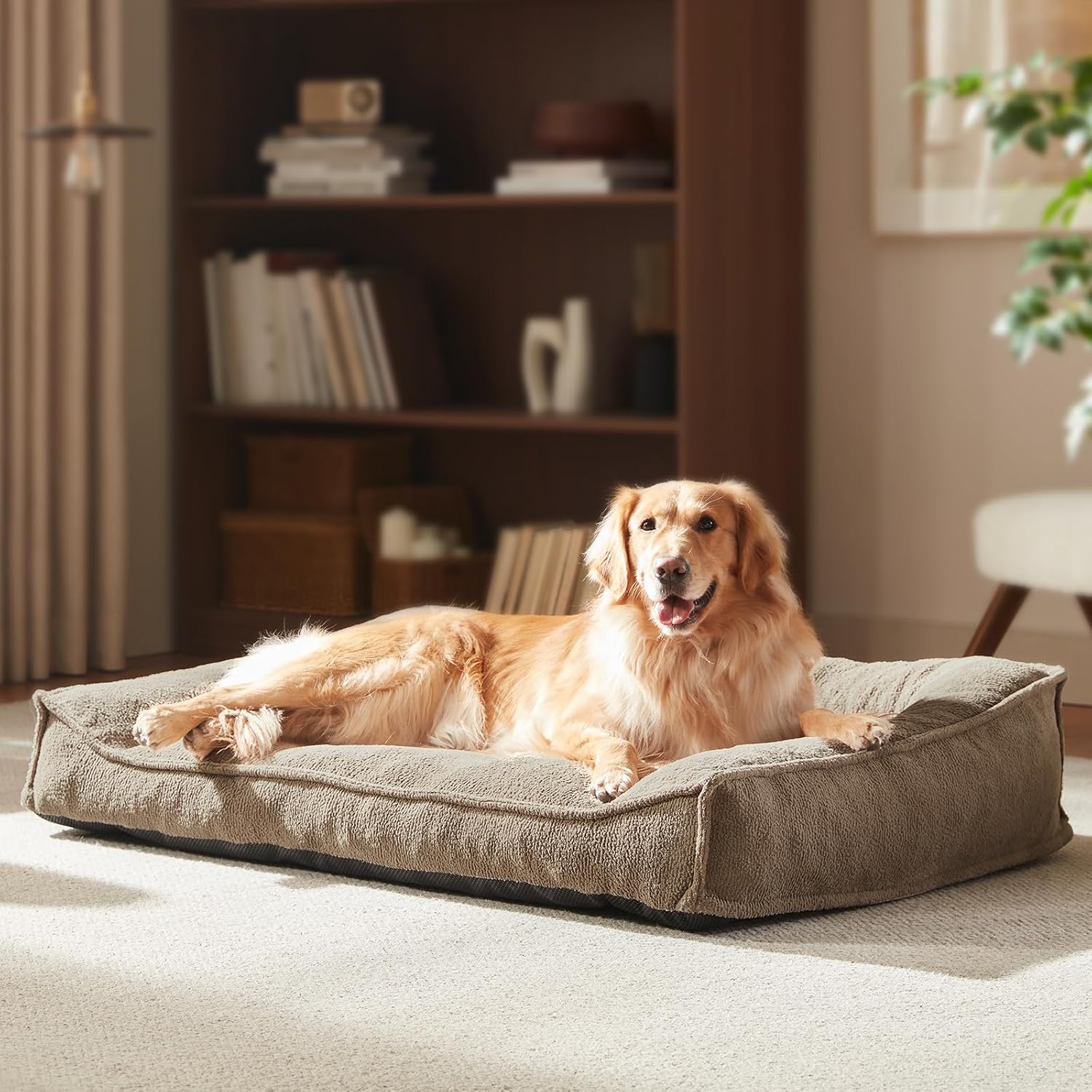
Best for the sprawler: FURTIME XL Orthopedic Dog Bed Large Sized Dog, Extra Washable Dog Couch 42"
 Visit on Amazon →
The 42 inch footprint is the reason this one is here. That is real estate for a golden who lies flat with his chin propped on an arm, and the couch shape with a back and raised sides gives him something to lean against instead of the wall. The cover is described as extra washable, which is the first thing I check on any bed, and the foam is described as orthopedic, which I verify with my palms the day it lands.
What I would watch: 42 inches is a lot of floor, so measure the corner before you order. Confirm the foam thickness in the listing, because couch style beds sometimes hide a thin slab behind a thick-looking cover. Wash cold, low tumble or air dry, and check the zipper after every wash. If the foam sinks under your hands or the cover pills inside the first month, use the return window. That is what it is for.
This is the bed for a 60 to 90 pound golden who sprawls, and for the owner who wants a bed that looks like a piece of furniture in the living room instead of a dog pillow on the floor.
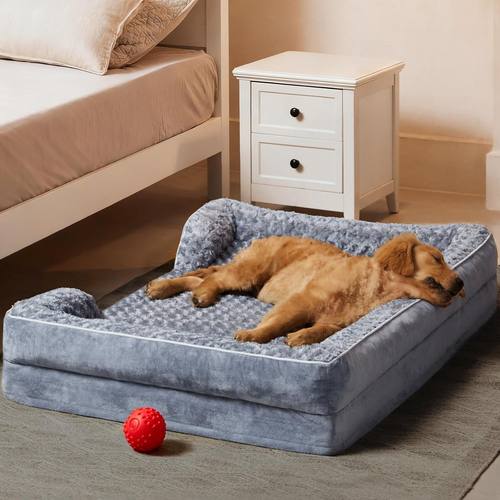
Best for the senior golden: WNPETHOME Orthopedic Washable Dog Bed Large for Senior Dog Cozy Sleep
 Visit on Amazon →
This one is built and named for senior dogs, and in my world that means three things: a lower step in, a cozy surround for a dog who wants to feel enclosed, and washable construction so you are not fighting odor on a bed that an older dog uses all day. A senior golden often sleeps more hours than a young one, which means more hours of pressure on the same hips, so the foam has to hold.
What I would watch: cozy usually means a raised rim, so check the entry height against your dog's mobility. If your golden is 95 pounds and sprawls across the whole bed, the flatter couch shape above is the better call. If he curls, leans, and likes a rim against his back, this shape fits that habit. Confirm the foam thickness claim in the listing and run the sink test on arrival.
This is the bed for the older golden, the one who sleeps hard, gets up slow, and deserves the softer landing.
How to set up a new bed so it lasts two years
The setup is not complicated, and it is where most owners lose the return window and the foam at the same time.
Step one: let the foam breathe. Unbox it and give it 24 to 48 hours in a warm room to finish expanding. Foam that arrives vacuum packed is compressed, and a dog who climbs on it at hour two flattens the edges permanently.
Step two: sink test before the dog gets on it. Press both palms into the hip area, measure how far the foam compresses with a ruler, and write the number in your notes with the date. That first number is your baseline for everything that follows.
Step three: wash the cover before first use. Cold water, gentle cycle, low tumble or air dry. Factory finishes bother dogs with sensitive skin, and Maple has taught me this lesson more than once.
Step four: place it where the dog already sleeps. Not the aesthetic corner. The spot he claimed three years ago.
Step five: start the clock in writing. Date, size, foam measurement. Two lines in a notes app is enough.
Step six: re-measure at 90 days and again at six months. Foam either holds or it does not, and a ruler tells you which before your dog's joints do.
Step seven: rotate the bed 180 degrees once a month. Dogs sleep on the same hip spot every night. Rotating spreads the load and buys you months.
Step eight: keep the box and packaging until day 30. The sink test beats the spec sheet, and the return window is the tool you use when it does not.
A caveat on smell: new foam can off gas for a few days. Air it out in a spare room and it fades. Do not panic and do not wash the foam itself.
What this costs per day
Sticker price is what marketing wants you to stare at. Cost per day is the honest number. Take the price on the listing, which you can see when you check the current Amazon price, and divide it by the days you expect to use the bed.
Run the arithmetic on two scenarios. A $150 bed that survives 730 days costs about 20 cents a day. A $60 bed that pancakes at 120 days costs 50 cents a day. The cheap bed is the expensive one. You just pay for it in four installments of disappointment instead of one payment up front.
That math is why I own a $300 bed for Biscuit and do not apologize for it. Two years in, it still holds shape, which works out to roughly 40 cents a day, cheaper than the $60 bed that died in four months. Both beds in this article sit in a range where the cost per day is reasonable if the foam holds. That "if" is the whole game, and the sink test is how you find out while the return window is still open.
Mistakes I see in golden retriever groups
Buying a size down "because he curls up." A 90 pound golden does not curl the way a terrier curls.
Donut beds for a big dog. A golden turns one into a pancake with a rim in about a week.
Trusting the word waterproof without checking what happens after wash number two.
Throwing the whole bed out when the cover tears. Covers and zippers are replaceable. A machinist I know taught me to tell a repairable bed from a throwaway, and most covers can be saved.
Spending big on a bed for an 8 week puppy who will chew the corner off it. Buy temporary for a puppy, buy quality at 18 months.
Never washing the cover and then blaming the bed for the smell.
Skipping the sink test, discovering a pancake at month four, and finding out the return window closed at day 30.
The short version
Measure your dog, not the photo. Demand four inches of dense foam and a cover you can machine wash. Do the sink test the day the bed arrives and write down the number. Put the bed where the dog already sleeps. Run the cost per day math before you check out, not after.
For the sprawler, the FURTIME couch shape in 42 inches. For the senior who curls and needs a low step in, the WNPETHOME. Then re-measure at six months, because foam either holds or it does not, and a ruler will tell you the truth faster than any review, including mine.