
Most beds sold as an orthopedic dog bed for a golden retriever are not orthopedic. They are two inches of low-density foam inside a cover with a confident word printed on the box, and a 95-pound dog turns one into a pancake before the first winter ends. I have watched it happen in my own living room, and I have the notebook entries with dates to prove it.
I am Sarah. I spent eight years as a vet tech before I started writing full time, and I live in Colorado with two golden retrievers. Biscuit is 95 pounds, six years old, and destroys things for fun. Maple is 60 pounds, three years old, and has skin that reacts to everything. Biscuit is the reason I stopped trusting product photos of small dogs lying on beds marketed for large ones.
This guide answers one question: how do you choose an orthopedic dog bed for a golden retriever without paying for marketing? The answer involves a tape measure, a washing machine, and one uncomfortable fact about foam. It does not involve a brand's opinion of itself.
Two beds made the cut below. Both are large, both have covers you can actually wash, and both sit in the range where a golden owner can start without a family meeting. Everything else here is method, and the method matters more than the pick.
Why you should trust me
Eight years as a vet tech taught me to look at a large dog's hips and elbows as a set of joints that will eventually have opinions. Ten years of writing about beds taught me that most of the orthopedic language on a box is decoration.
I keep a notebook. Every bed that comes into this house gets measured the day it arrives and again six months later: foam thickness, sink depth under my weight, weight after a wash cycle, zipper condition. I have taken apart more covers than I can count and repaired the ones worth repairing. The machinist who fixed my zippers taught me to tell a bed you can service from a bed you throw away.
Two things I will not do. I will not pretend to give medical advice. If your golden is limping, favoring a hip, or struggling to rise, that is a vet conversation, not a bed conversation. A bed can support a dog; it cannot treat one. And I will not quote a foam density number for a product unless the maker publishes it. I measure, and when I cannot measure, I say so.
How I picked and how I tested
The short version: I trust a tape measure and a wash cycle more than a spec sheet with the word premium on it.
For this guide I stuck to beds that clear four filters. Memory foam or a documented foam layer, not polyfill. A cover that zips off and goes into a machine. A footprint that fits a sprawled golden, not a curled one. A price a normal person can pay without a speech to their partner.
Then I ran the checks I run on everything. Sink test: lie on the bed, measure how far the foam compresses under your weight, and do it again in six months. A bed that sinks an inch and stops is doing its job. A bed that sinks to the floor is a hammock. Wash test: count how many cycles the cover survives before the backing separates or the zipper pulls. Zipper test: metal teeth, a tab you can grip, a seam that does not pucker. Base test: push the bed across a hardwood floor with your foot. If it slides, your golden will turn it into a sled.
What I did not do is invent numbers for the two beds below. I am not going to hand you a sink depth I did not take. What I will tell you is what each bed claims, what it is built for, and where I would expect it to fall short.
Two beds worth measuring
Both of the beds below are large, both are washable, and both are aimed at the dog you already have. Start here, then read the measurement steps before you buy anything, including these.
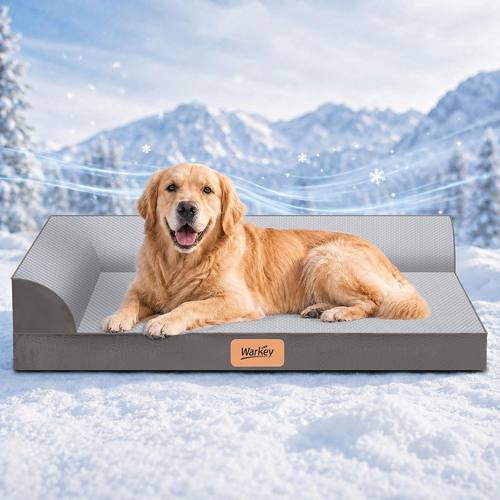
Budget pick: Cooling Orthopedic Dog Bed for Large Dogs, Memory Foam Pet Bed with Removable Washable Cover & Non-Slip Bottom, Comfortable Dog Couch Bed for Golden Retriever, Size: 40"*31.9 * 8.1"
 Visit on Amazon →
This one names your dog in the listing, which usually makes me roll my eyes, but the spec sheet does the work here. Memory foam, a removable washable cover, and a non-slip bottom are the three things I ask for first, and this bed lists all three. The 40 by 31.9 inch footprint with an 8.1 inch height gives a golden room to sprawl rather than curl, and the cooling layer is the part Maple would care about in July.
For a 60 to 75 pound golden, or for a household where the bed lives in a warm room, this is the sensible starting point. The non-slip bottom is not a marketing garnish either. On a hardwood floor, a sliding bed is a bed your dog abandons.
Flaws but not dealbreakers: Cooling is a fabric claim, not a temperature reading. It will feel cooler than a fleece cover, and that is the whole promise. If your golden sleeps hot enough to soak a bed, a cooling cover is a comfort feature, not air conditioning.
Anyone with a mid-size golden, a warm bedroom, or a dog who drags a bed around the house should look here first.
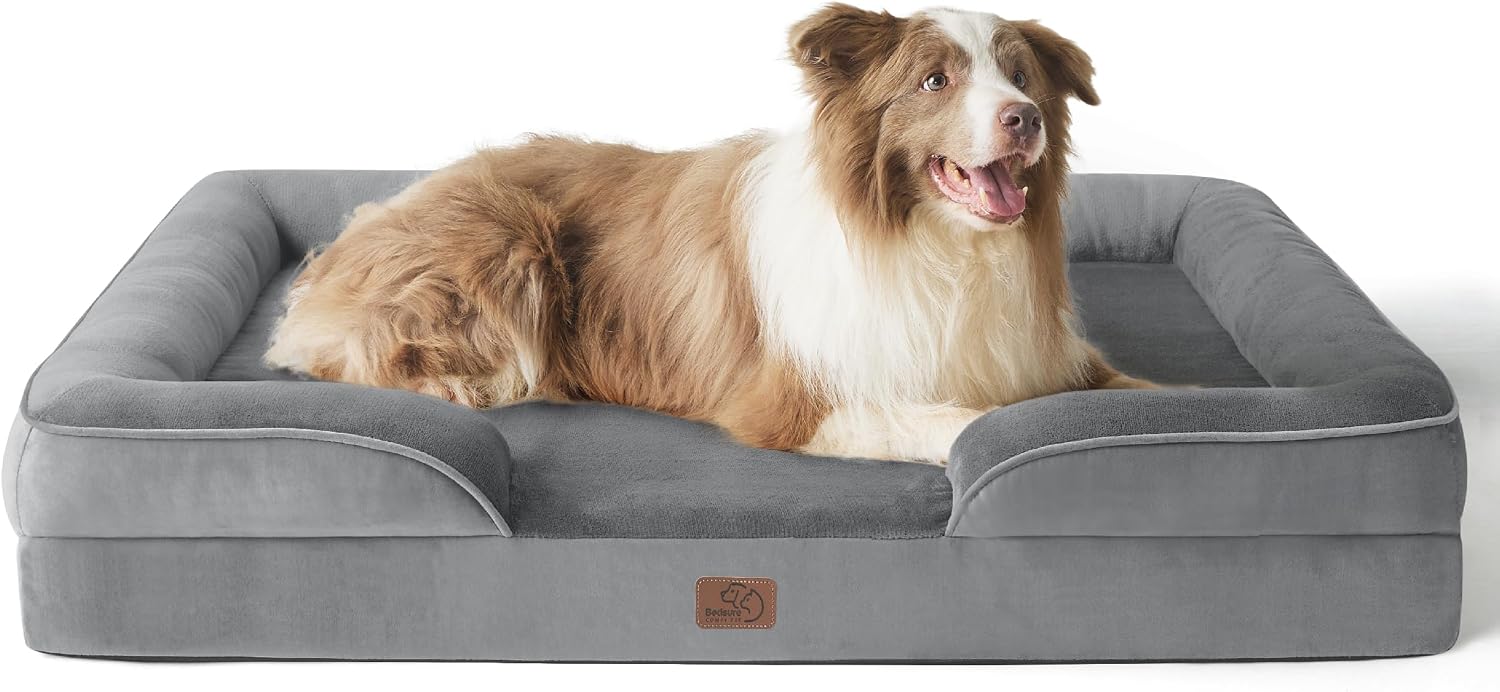
Our pick: Bedsure Orthopedic Dog Beds Large Sized Dog Washable Original Design
 Visit on Amazon →
This is the one I would point a first-time golden owner toward when they want a large bed that is genuinely machine washable. The washable part of the name is the feature that matters. A golden sheds, drools, and occasionally brings the yard inside, and a cover you cannot pull off and launder is a cover you end up scrubbing by hand at 10 p.m.
Large sized means large sized for a big dog, so measure your floor space before you commit. The Original Design build is a straightforward platform bed rather than a bolstered nest, which suits a dog like Biscuit who lies across the entire surface and ignores bolsters completely. If your golden likes a headrest, this is not the shape for you.
Flaws but not dealbreakers: Every bed called orthopedic deserves the same question, which is how thick the foam actually is. Ask before you buy, or measure it the day it arrives. If the answer is under three inches, treat it as a comfortable mat and adjust your expectations and your cost-per-day math accordingly.
Anyone who wants a large, washable, no-drama bed for a golden who sleeps flat should start here.
What to measure before you spend anything
Step one: measure your dog, sprawled. Not standing, not curled. Get your golden flat on the floor with legs out, measure nose to tail base, then add six to eight inches. That is your minimum footprint. A 95-pound golden takes up more floor than most people expect, and an undersized bed is the most common mistake I see in owner photos.
Step two: ask for foam thickness in inches. Three inches is the floor for a golden. Four is better. Two inches is a mat, and I do not care what the box says. This is the number that decides whether the bed is still a bed in month eight.
Step three: ask for foam density if the maker publishes it. Density is measured in pounds per cubic foot, and it is the difference between foam that rebounds and foam that remembers your dog permanently. Three to four pounds per cubic foot is a real bed. Around one and a half to two is a scam with a nice photo.
Step four: check the cover closure. Zipper, not velcro. Metal teeth, not plastic. A cover that comes off in one piece and goes back on without a wrestling match is a cover that gets washed.
Step five: check the base and the climate. Non-slip bottom or nothing, because a bed that slides is a bed that ends up against a wall. Then decide cooling versus warmth: a cooling cover for summer and warm rooms, a plush cover for a cold floor in January. In Colorado I keep both and swap.
Step six: run the sink test yourself, then repeat it. Lie on the bed. If your hips reach the floor, return it. If the foam pushes back when you stand up, keep it, and write the date on the tag. Do the same test every six months. Foam failure is gradual, and your dog will not file a complaint. The notebook catches it.
Where most golden owners go wrong
Donut beds. A 90-pound golden turns a donut bed into a pancake with a rim. They are built for small dogs and sold with photos of puppies.
Thin foam with a big word on it. If the spec sheet does not state a thickness, that is your answer.
Cheap cooling gel. When a gel layer fails, you get a wet floor and a confused dog. Buy cooling as a cover fabric, not as a mystery insert.
Beds sized for the curl instead of the sprawl. Goldens sleep long.
Skipping the wash test. If you cannot wash it, you will replace it, and you will replace it sooner than you think.
And the one that is not about beds at all: if your golden is stiff getting up, slow on stairs, or licking at a joint, see your vet. A bed supports a dog with a diagnosis. It does not diagnose anything.
The cost-per-day math
Sticker price is what marketing wants you to look at. Cost per day is the only honest comparison, and the division is simple: what you paid, divided by how many days the bed stays a bed.
Here is the trap. A cheap bed that flattens in four months costs a fraction of the price and lasts an eighth as long. Run the division and the better bed wins every time, and you pay for the good one all at once instead of buying the bad one three times. My own rule is blunt: a bed has to survive two years with a 90-pound dog. Under that, it is a toy, not a bed.
That math is also why I do not put a puppy on a top-tier bed. Buy the cheaper one, let the puppy teeth do their damage, and upgrade when the dog stops chewing. You will spend less overall and you will not be angry about a shredded cover.
Questions I get from golden owners
Is memory foam actually better for a golden? It is better when it is thick and dense enough to hold shape, which is why thickness and density matter more than the words. Two inches of memory foam is not better than four inches of good support foam. Ask for numbers.
How big should a golden retriever's bed be? Bigger than you think. Measure your dog sprawled out and add six to eight inches. Most large beds on the market are large for a Labrador and snug for a 95-pound golden.
How often should I replace the bed? When the sink test stops passing. If your hand goes to the floor, the bed is done, no matter how good the cover still looks. Two years is my minimum expectation for a real bed.
Can a bed help with hip problems? A supportive bed can make rest more comfortable for a dog with a diagnosed joint issue, and your vet is the person who tells you what else is needed. I do not give medical advice and I will not pretend a bed is treatment.
The bottom line
Choosing an orthopedic dog bed for a golden retriever is a measurement problem, not a brand problem. Measure your dog sprawled. Demand three inches of foam minimum. Refuse a cover that cannot be washed. Check the base, run the sink test, and write the result in a notebook you will actually open again in six months.
The two beds above are a reasonable place to start: one for a warm room and a mid-size golden, one for a big dog who sleeps flat and needs a cover that survives the laundry. Neither is a magic fix, and neither is a waste of money if you check the numbers first.
Buy the bed your dog measures into, not the bed the box says he deserves.