Most beds sold for big dogs are the wrong size, and the dog pays for it in his elbows. Buying a golden retriever dog bed is not a style decision. It is a measurement problem, then a materials problem, then a laundry problem. Get those three right and a 95-pound dog sleeps on the same bed for two years instead of destroying a cheap one in four months.
I run a two-layer setup at my house. There is a base bed that has to hold its shape under a big dog, and there is a cooling layer for the warm months, when a golden turns into a furnace on the floor. In Colorado that is roughly June through September, plus every unseasonably hot afternoon in between.
This is the order I do it in: measure the dog, choose the base, add the cooling layer, set it up where the dog already sleeps, then keep it clean. The two products below are the ones I would hand a friend with a big golden today. Everything else is the process.
Why you should trust me
I spent eight years as a vet tech before I started writing about gear full time, and I have two goldens of my own. Biscuit is 95 pounds, six years old, and has destroyed more zippers than I can count. Maple is 60 pounds, three years old, and reacts to everything. I have lived with more than 60 dog beds over ten years and I keep a notebook with real dates and real numbers in it: sink depth, weight after washing, days until the foam flattens.
I do not review food, medicine, or supplements. My scope is beds, mats, crates, and sleep accessories. Joint problems and skin problems belong to your vet, not to me. What I can tell you is what survives a big dog and what does not.
How I picked what is on this list
Four things decide whether a bed is worth your money, and none of them is the word printed on the box.
First, the cover has to be machine washable. If I cannot wash it, I will not buy it. A golden sheds year round and drools on everything he loves.
Second, the size has to fit a dog who sleeps sprawled on his side with his legs out, not curled up like a puppy in a photo shoot.
Third, the foam has to hold up. Density is the number that matters, measured in pounds per cubic foot. Three to four pounds per cubic foot is real support. One and a half to two is a mat with big letters on the box.
Fourth, the waterproof claim has to survive a wash. A cover that delaminates on the first cycle was never waterproof. It was coated.
Both products below clear those four tests on paper, and both sit in a range where a golden owner can try the two-layer setup without rearranging the household budget. Check current Amazon price on each before you commit, because these things move.
Measure your golden before you buy anything
This takes ten minutes and it saves you a return.
Step one: measure the dog. Run a tape from the base of the tail to the tip of the nose while he is standing. Biscuit is 38 inches. That is your starting number.
Step two: add 8 to 10 inches. A dog needs room to stretch. A golden who cannot stretch will hang his head off the edge, which is how you get neck and shoulder stiffness in an older dog.
Step three: watch how he lies down for two nights. Goldens sprawl. If your dog sleeps flat on his side with his legs straight out, you need the long dimension. If he curls tight, you can go slightly smaller, but not much. A 90-pound dog in a 30-inch bed is a dog on the floor by morning.
Step four: measure the floor space, including wall clearance. A bed that blocks the hallway gets moved to the garage, and a bed in the garage is a bed your dog will not use.
Step five: put the bed where the dog already sleeps. This is the step owners skip. Biscuit picked the corner of the living room by the sliding door two years ago and has never slept anywhere else. I put the bed there. That bed is now his base of operations.
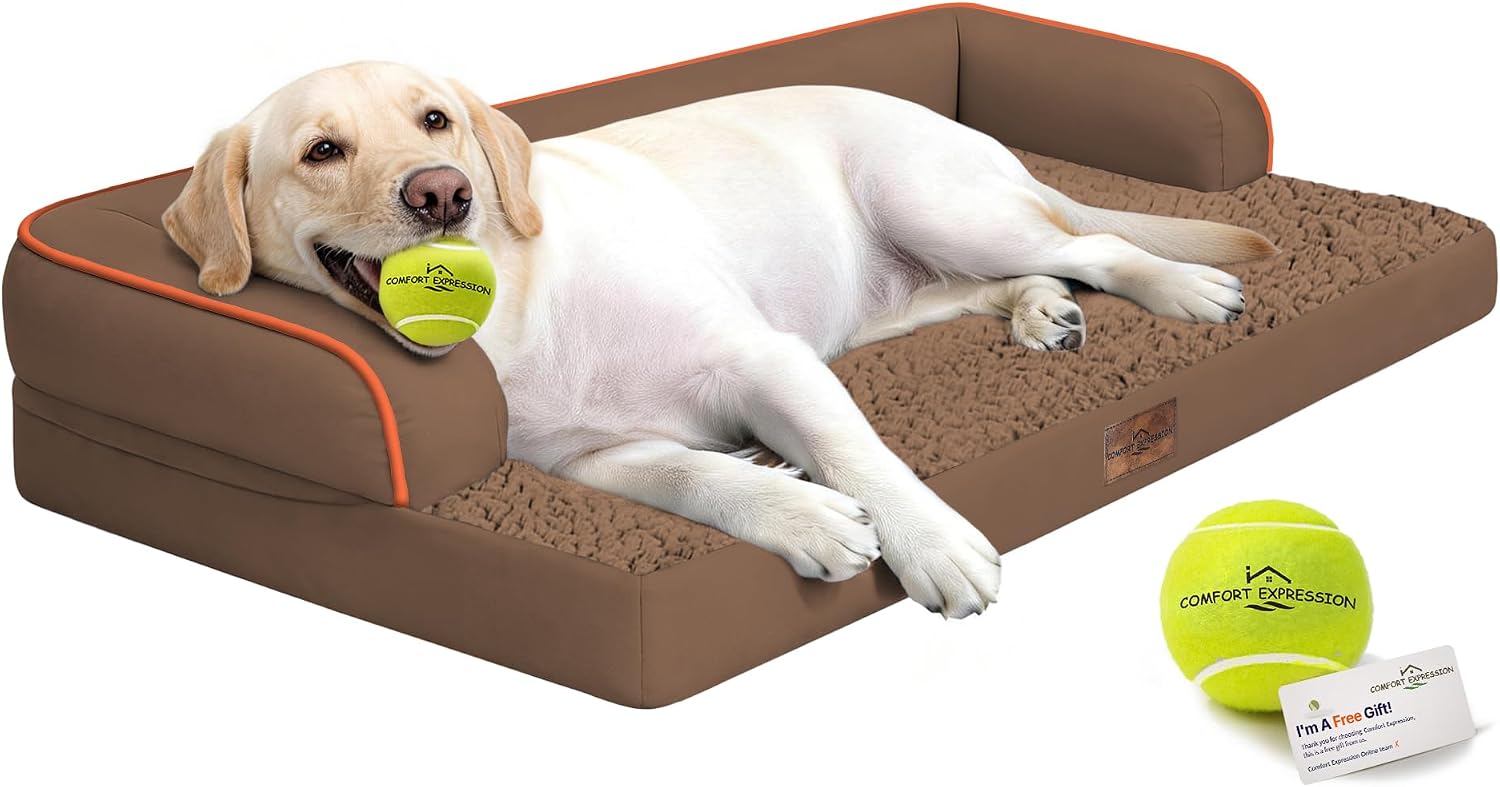
The everyday base: Comfort Expression Waterproof XXL Dog Bed with Bolster for Extra Large Dogs
 Visit on Amazon →
This is the base layer: an XXL bed built for extra large dogs, with a bolster around the edge and a waterproof cover. For a golden in the 75 to 100 pound range, XXL is the right neighborhood, and the bolster gives a dog who likes to rest his head on something a place to do it. Check current Amazon price.
Two things to inspect the day it arrives. First, unzip the cover and press the foam. If it springs back and feels dense rather than airy, you got what you paid for. If it stays compressed under your hand, send it back before the dog claims it. Second, run a hand along the zipper and the seams. The zipper is the first thing to fail on any bed, and a bed with a bad zipper is a bed with a cover you can never wash.
Flaws but not dealbreakers: A bolster is a preference, not a requirement. Biscuit ignores his and lies across the whole bed anyway with his head hanging off the front. Maple uses hers every night. If your dog is a sprawler, the bolster just eats a little usable surface. And waterproof covers, by definition, breathe less than plain fabric, so in a hot room you will want the cooling layer on top.
This bed suits a golden who sleeps in one spot every night and needs a washable cover more than he needs a designer print.
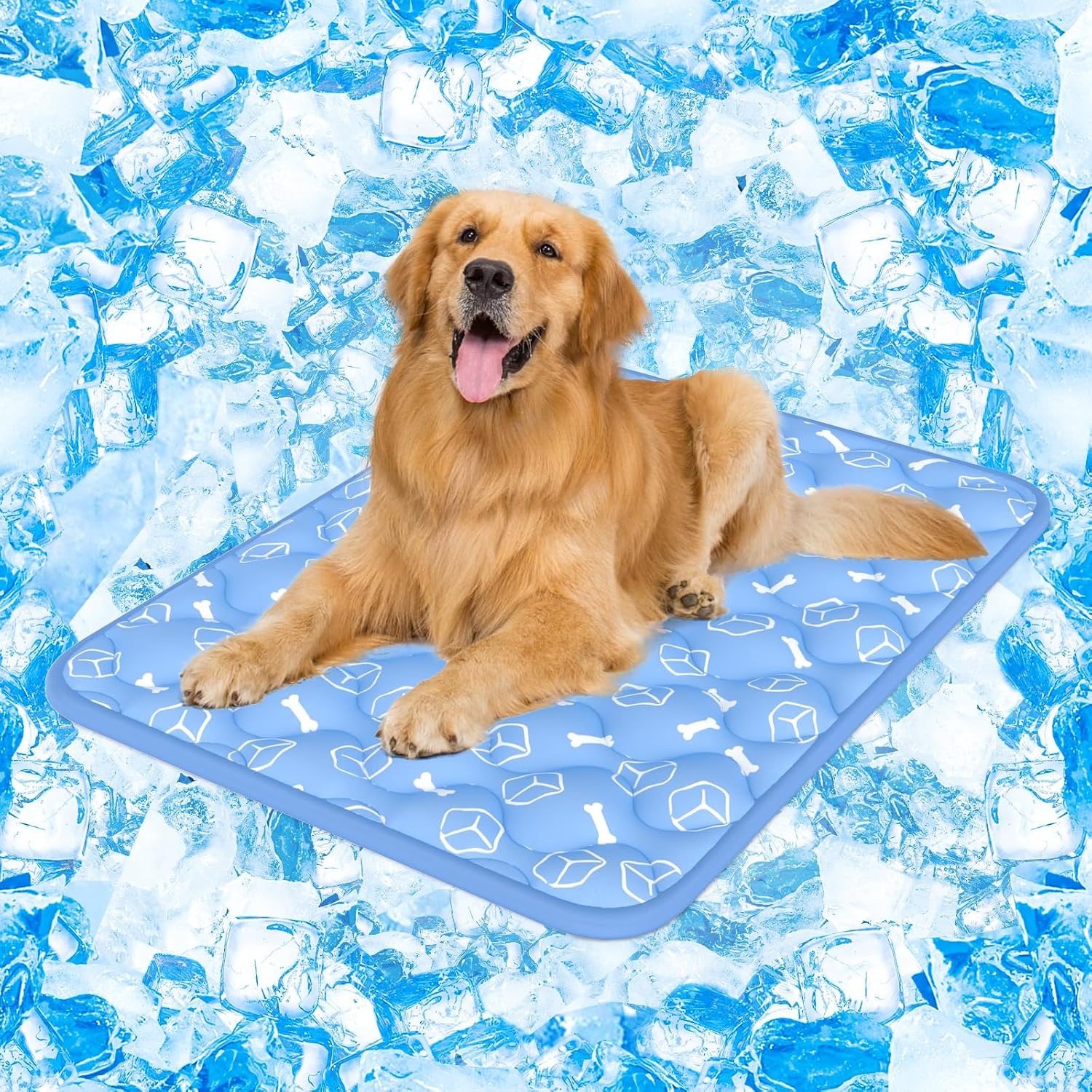
The warm-weather layer: Rywell Dog Cooling Mat 2.0, Ocean Blue, 44" x 32" Thick & Durable Cooling Mat for Extra Large Dogs, Long-Lasting Cool with Waterproof & Color-Changing Arc-Chill Tech (Q-Max>0.5) Washable& Non-Toxic
 Visit on Amazon →
This is the layer that goes on top of the base bed when the house gets warm. It is a 44 by 32 inch mat sized for extra large dogs, and it uses a pressure-activated cooling fabric rather than a gel pack, which is the detail I care about most. Cheap gel mats burst, and a burst gel mat means a wet dog and a ruined floor. Check current Amazon price.
The spec worth knowing is the Q-Max number. Q-Max measures how fast a fabric pulls heat away from skin, and a value above 0.5 is roughly where you actually feel a difference. That number is printed right in the product name, which is more than most cooling products will tell you. The mat is also listed as washable and non-toxic, which matters, because a hot dog will lick whatever he is lying on.
Flaws but not dealbreakers: The color-changing fabric is a novelty, not a feature. It shifts color with temperature. Cute, harmless, ignore it. The bigger issue is airflow. A cooling mat only works while air can move across it, so do not bury it under a heavy blanket or a thick bed cover, because you will insulate the one surface that was supposed to pull heat away. Put it on top, never underneath. And no mat replaces shade and water on a genuinely hot day. If your dog is panting hard, drooling heavily, or seems disoriented, that is a vet call, not a shopping decision.
This mat suits any golden who runs hot, and it is the easiest upgrade for a dog who abandons his bed in July and sleeps on the tile.
The setup, in five steps
Step one: wash the cover before the dog ever touches it. Cold water, gentle cycle, air dry. Covers shrink in a dryer, and a shrunken cover will not go back on the foam. This also tells you immediately whether the waterproof layer survives a cycle.
Step two: put the base bed where the dog already sleeps. Not the corner you think looks better. The spot he picked.
Step three: add the cooling mat on top for the warm months. In winter, pull it and store it flat. If your golden runs hot year round, leave it on. A dog who pants on a cool January night is telling you something.
Step four: give it a week and do not force it. Put a worn t-shirt of yours on the bed for the first few nights. The smell does more than any coaxing. Do not stand over the dog clapping.
Step five: set a wash schedule and keep it. Cover every two weeks, more often if the dog is a drooler. Vacuum the foam while the cover is off. Check the zipper and the seams once a month, the way you would check a kid's backpack.
What to check before you buy any bed
Ignore the word on the box and check these instead.
Foam density. Read the spec or ask. Three to four pounds per cubic foot is a real bed. Below two is temporary.
Thickness. Two inches of foam is not orthopedic. It is a mat with big letters on the box. If a listing calls something orthopedic and lists two inches, keep scrolling.
Washability. The cover has to come off and go into a machine. Hand wash only means it will never be washed.
Zipper and seam quality. A repairable bed is worth fixing. A throwaway bed is not. I have replaced three zippers on beds that deserved it and thrown out two that did not.
Warranty behavior. What a brand does when a bed fails tells you more than any marketing page. Ask in a breed group what happened when someone's bed flattened at month eight.
The cost-per-day math
Sticker price is what marketing wants you to look at. Cost per day is the only honest comparison. Take the price of the bed, divide it by the number of days you expect to use it, and compare that number to the cheap bed you would have to replace twice.
The bed that holds its shape for two years wins that math almost every time, even when it costs several times as much up front. The catch is that you pay for it all at once, which is why it feels expensive in the moment. Check current Amazon price on both products above and run the division yourself with real numbers.
Mistakes I see in golden groups
Buying a donut bed for a 90-pound dog. A golden turns a donut into a pancake with a rim in about three months.
Buying a cheap bed labeled orthopedic and replacing it twice a year. Two cheap beds cost more than one good one, and the dog sleeps badly in between.
Skipping the wash test. If the cover cannot be washed, the bed becomes a smell problem within a month.
Putting the cooling mat under the bed cover. You just insulated the thing that was supposed to cool the dog.
Buying before measuring. The most common return in every large dog group I read is a bed that was one size too small.
FAQ
How big should a golden retriever dog bed be? Measure from the base of the tail to the tip of the nose while the dog is standing, then add 8 to 10 inches. For most adult goldens that lands in the XL to XXL range, and a sprawler needs the long dimension.
Do cooling mats actually work for big dogs? A pressure-activated mat with a Q-Max above 0.5 does pull heat away while air moves across it. It is a comfort tool, not a medical device, and it does not replace shade, water, and a vet call if your dog is struggling in the heat.
The short version
Measure the dog, buy the base bed in the size the measurement gives you, wash the cover before the first nap, and add a cooling mat on top for the warm months. Then leave the dog alone to decide. That is the whole job, and it is the difference between a bed that lasts two years and a donation to the landfill.