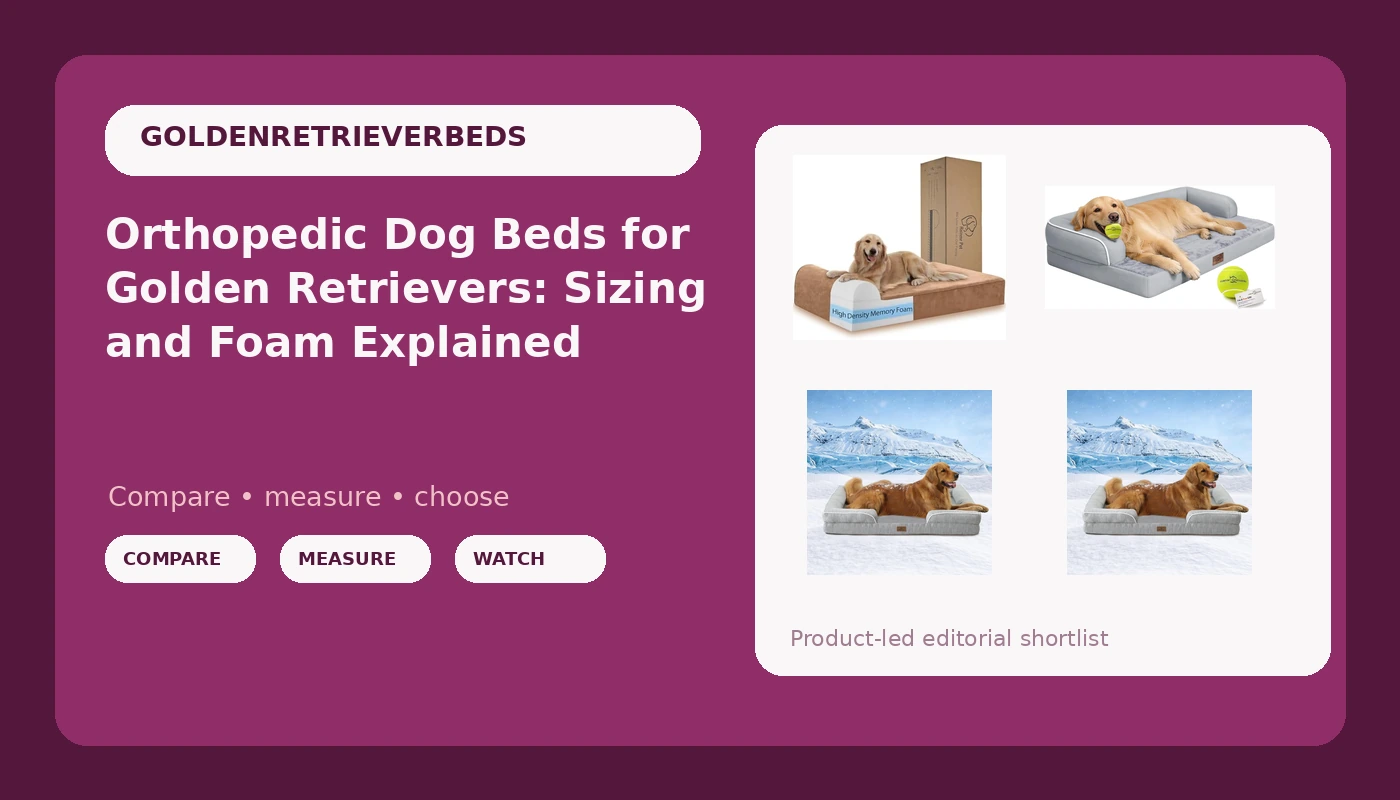
A golden retriever is a large dog with a large dog's joints, and a bed built for a 20 pound terrier becomes a pancake under 90 pounds of retriever within a season. That is the whole problem with shopping for orthopedic dog beds for golden retrievers. The category is full of products that use the word orthopedic while offering two inches of low density foam, and the listing photos almost always show a dog half the size of yours. The four beds below are all sold as large or extra large orthopedic options, and they differ in the things that actually matter to a golden: foam thickness, footprint dimensions, whether the cover comes off for washing, whether a waterproof liner sits underneath it, and whether the sleep surface is built to run cool.
Related: How Thick Should a Large Dog Bed Really Be? A Foam Spec Guide →
Quick answer
For a full grown golden between 60 and 95 pounds, look for at least 7 inches of foam, a removable and machine washable cover, a waterproof liner under that cover, and a footprint of roughly 48 by 30 inches or larger. All four beds here meet the thickness and washability bar. The real differences are footprint, cooling surface, and whether you want a raised side for head resting. Do not label a product the quietest, fastest, safest, or best unless the available evidence supports that distinction.
Four useful options
| Model | Best fit | What stands out |
|---|---|---|
| Rainmr Orthopedic Dog Beds for Large Dogs, 7" Memory Foam, 48"x30"x7" | Goldens who sprawl flat | 7 inches of memory foam, waterproof liner, microsuede cover, nonskid bottom |
| Comfort Expression Orthopedic XL Dog Bed for Large and Extra Large Dogs | Shoppers who want an XL footprint at the low end | Sold specifically as an XL bed for large and extra large breeds |
| Cooling Dog Bed, Dual-Cooling Design, Q-Max >0.4, Extra Large (48" L x 32" W x 8" Th) | Hot sleepers in warm rooms | 8 inch orthopedic foam, cooling surface, raised sides, waterproof lining |
| Cooling Dog Bed, Dual-Cooling Design, Q-Max >0.4, Large (42"L x 30"W x 7.5"Th) | Goldens who like a headrest | 7.5 inch foam, cooling surface, sides, removable cover, nonskid bottom |
The 7 inch memory foam option: Rainmr Orthopedic Dog Beds for Large Dogs
This is the bed to start with if your golden sleeps flat and spread out, which most of them do. Seven inches is the thickness number that separates a genuine orthopedic bed from a mat with big letters on the box, and 48 by 30 inches is a real large dog footprint rather than a stretched medium. The trade-off to watch is density. Thickness is visible in a photo, but density is the number that decides whether foam holds its shape or flattens, and listings rarely publish it. Microsuede also sleeps warm, so if your golden runs hot in summer, look at the cooling options below before you commit.
The XL budget option: Comfort Expression Orthopedic XL Dog Bed for Large and Extra Large Dogs
Budget beds are not automatically bad beds. They are usually thinner beds, and thin foam under a 90 pound dog has a predictable lifespan. The reason this one belongs on the list is the XL sizing claim, since most cheap beds marketed to big dogs are actually medium beds with optimistic copy. Treat it as a temporary bed with a possible upgrade later, or as the bed for a second sleep spot in a room where Biscuit and Maple only nap. Ask the seller for foam thickness and density before you buy, and if the answer is vague, assume you are buying 12 to 18 months of use rather than five years.
The extra large cooling option: Cooling Dog Bed, Dual-Cooling Design, Q-Max >0.4, 48" x 32" x 8"
Eight inches of foam in a 48 by 32 inch footprint is generous for a golden, and the extra inch over the Rainmr bed is the kind of detail that matters for a dog carrying 95 pounds on one hip. The cooling claim is the part worth understanding rather than trusting. A cooling surface works by moving heat away from the body, and it only does that if air can reach it. Push this bed into a corner, cover it with a blanket, or stack it against a radiator and you have paid for a feature you are not using. The raised sides eat into usable sleeping area too, so measure your dog nose to tail before you decide the footprint is big enough.
The large cooling option: Cooling Dog Bed, Dual-Cooling Design, Q-Max >0.4, 42"L x 30"W x 7.5"Th
This is the same cooling concept as the bed above in a 42 by 30 inch footprint with 7.5 inches of foam. That is a fine size for a 60 to 70 pound golden, and it is a tight size for a 95 pound male who sleeps on his side with his legs out. The nonskid bottom is a small but real advantage on hardwood, since a heavy dog pushing off a sliding bed is how covers tear at the seams. If you are choosing between the two cooling beds, the deciding question is not which one cools better, it is which one your dog fits in without hanging over the edge.
Prices and availability may change. Product images, names, and retailer links are matched to verified listings. No current price, rating, stock status, or measured result is stated here without current evidence.
Thickness, density, and the number listings hide
Foam thickness is easy to sell because you can photograph it. Foam density is harder to sell because it is an invisible number, usually expressed in pounds per cubic foot. A 7 inch slab of low density foam will compress under a 90 pound dog just as deeply as a 4 inch slab of good foam, and it will stay compressed. This is why two beds that both say orthopedic can behave completely differently six months in.
The practical test is the sink test. Press your palm, or better, your knee, into the foam and watch how far it goes down and how quickly it comes back. Foam that recovers slowly is doing its job. Foam that stays dented after you stand up has already started to fail. Do this in the store if you can, and if you buy online, do it the day the bed arrives, while the return window is still open.
There is also a cost per day calculation worth doing before you write off an expensive bed. Divide the price by the number of days you expect to use it. A cheap bed that flattens in four months costs more per day than a thick bed that holds its shape for years, and the only difference is that you pay for the good one all at once.
What a Q-Max rating tells you about a cooling bed
Q-Max is a measurement of how quickly a fabric pulls heat away from whatever is touching it. Higher numbers mean a stronger cooling effect at the moment of contact. The two cooling beds here are listed with a Q-Max rating above 0.4, which is the kind of specific number worth having, because it can be compared instead of just asserted.
What Q-Max does not tell you is how long the effect lasts. A cooling surface is not a refrigerator. It feels cool because heat moves from the dog into the fabric and then into the air, so airflow and room temperature do most of the work. A cooling bed in a 78 degree room with a fan moving air will feel very different from the same bed in a closed, still room. It is also not a substitute for a vet visit if your dog is panting heavily in moderate weather. That is a health question, not a bedding question.
If you want to compare the four beds systematically, work through these steps in order:
- Measure your golden from nose to tail while stretched out, then add 4 to 6 inches.
- Measure the floor space where the bed will actually live, including clearance for a wall or furniture.
- Confirm the cover is removable and machine washable, and that a waterproof liner sits beneath it.
- Confirm the foam thickness in inches and ask for density in pounds per cubic foot if it is not published.
- Divide price by expected usable days, then check the warranty terms before you decide.
Practical guidance for golden retriever owners
- A cover that cannot go in the washing machine is a deal breaker. Goldens shed, drool, and bring in whatever the yard had that day.
- Check the zipper the day the bed arrives. A cheap zipper fails long before the foam does, and it is the single most common reason a good bed gets thrown out.
- Rotate the bed every few months if your dog always sleeps on the same end. Foam compresses where the weight lands, not evenly across the slab.
- Keep a ruler handy and note the foam height every six months. A half inch of compression over a year is normal. Two inches is a bed that needs replacing.
- If your golden is a puppy, buy cheap now and upgrade at full size. Puppies chew seams, and a destroyed $300 bed is a worse outcome than a destroyed $40 one.
- Wash the cover on the gentle cycle and air dry it if the label allows. Heat is what delaminates the waterproof backing that makes a liner useful in the first place.
Which option should you choose?
Choose the Rainmr Orthopedic Dog Beds for Large Dogs when you want a thick flat bed with a waterproof liner and a washable microsuede cover, and your golden sleeps sprawled out rather than curled. Choose the Comfort Expression Orthopedic XL Dog Bed for Large and Extra Large Dogs when the XL footprint is the priority and you are comfortable treating the bed as a shorter term purchase or a secondary sleep spot. Choose the Cooling Dog Bed, Dual-Cooling Design, Q-Max >0.4, 48" L x 32" W x 8" Th when your golden runs hot, your floors get warm in summer, and you have the room for the biggest footprint in this group. Choose the Cooling Dog Bed, Dual-Cooling Design, Q-Max >0.4, 42"L x 30"W x 7.5"Th when your golden is closer to 60 or 70 pounds, likes to rest his head on a raised side, and you want the cooling surface without giving up floor space.
One caveat applies to all four. None of these listings publish foam density, which is the number that predicts how the bed performs in year two rather than week two. Thickness, footprint, cover construction, and liner are all verifiable from the listing. Density usually is not, and that is the gap a warranty and a return window are there to cover.
The bottom line
For a golden retriever, the non negotiable features are 7 inches or more of foam, a removable washable cover, a waterproof liner, and a footprint that matches your dog's stretched out length rather than his curled up one. All four beds here clear the thickness and washability bar, and the choice between them comes down to footprint and sleep surface. Buy the largest bed your room allows, keep the receipt, and do the sink test on day one while you can still send it back. That approach costs less over five years than replacing a thin bed every time it flattens.