
A golden retriever dog bed has one job that most beds on the market fail: hold up a dog that weighs between 60 and 95 pounds, every single night, for years. Biscuit is 95 pounds and has destroyed more bedding than I care to count. Maple is 60 pounds with skin that reacts to everything, so her cover gets washed twice a month. Two dogs, two different requirements, and the same conclusion every time. The bed matters more than almost any other piece of gear you buy for a large breed.
I spent eight years as a vet tech before I started writing full time, and I have kept a measurement notebook on every bed that has come through this house for the last decade. The pattern is boring and consistent. Beds that say orthopedic on the box and never publish a foam spec flatten inside four months. Covers that cannot go in a washing machine turn into a smell problem by month three. The cheap bed almost always costs more per day than the expensive one, because you end up buying it twice.
What follows is the way I sort through it: the two beds I would start with, and then the step-by-step process for choosing and setting up a bed for a golden.
Why you should trust me
I am not a veterinarian and I do not pretend to be one online. What I did for eight years was work as a vet tech, and a large share of those appointments were large-breed joint cases. I have handled more golden retrievers with hip and elbow problems than I can remember, and I have watched what happens when a dog sleeps on the floor for a year because the bed gave out.
What I do now is measure. Ten years, more than 60 beds through this house, a notebook with sink depth and cover weights and dates. When a bed flattens, I have the number from the day it arrived and the number from six months later. When a cover shrinks after a hot wash, I have that too. A review without measurements is just enthusiasm, and enthusiasm does not hold up a 95-pound dog.
How I judge a bed before it earns floor space
Four checks, in this order.
Foam spec first. Density in pounds per cubic foot and thickness in inches. If a listing will not tell you either number, that is your answer. Three to four pounds per cubic foot is real support. One and a half to two pounds is a mattress pad with a nice photograph on the box.
The sink test second. Press your knee into the middle of the bed and watch how far the foam compresses. A bed that bottoms out under your knee will bottom out under a golden. If you can feel the floor through the foam, the dog will feel the floor through the foam, and the whole point of the bed is gone.
Cover third. Machine washable, dryer safe, and a zipper you can actually operate. Maple's skin means I wash covers often, and a cover that delaminates on the first hot wash is a cover that just cost you the bed.
Cost per day last. Divide the price by the number of days you expect the bed to last. That number is the only honest price. Everything else is marketing.
The two beds I would start with for a golden
Different dogs need different beds, and the two below cover the two situations I see most often: the senior golden who needs real support, and the dog who eats bedding.
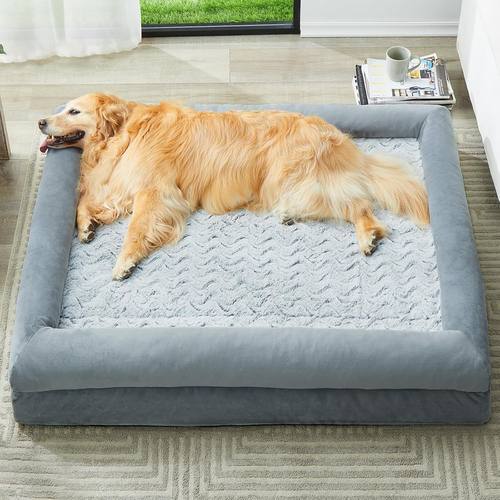
Our pick for senior goldens: WNPETHOME XXL Extra Large Orthopedic for Senior Dog BedComfy Sleeping
 Visit on Amazon →
XXL is the correct size class for a golden, and that matters more than most people think. A 90-pound dog needs room to stretch out flat, not curl into a ball, and a bed that is too small puts the elbows and hips right at the edge where there is no support underneath them.
The word orthopedic is doing a lot of work on this listing, and it is the one claim I never take at face value. Before you buy, get the foam thickness and the density. A senior golden needs a bed that is thick enough to keep the joints off the floor and firm enough to hold that thickness past the first winter. Check current Amazon price, then check the foam spec, and let the spec decide.
For a senior dog, also look at entry height. A bed that sits a few inches tall at the edge is easy for a stiff dog to step onto. A bed with a high bolster wall is not, no matter how good it looks in the photo.
Flaws but not dealbreakers: The orthopedic label is only as good as the foam inside, and that is on you to verify. If the density number never appears anywhere, treat this as a comfortable bed rather than a medical one.
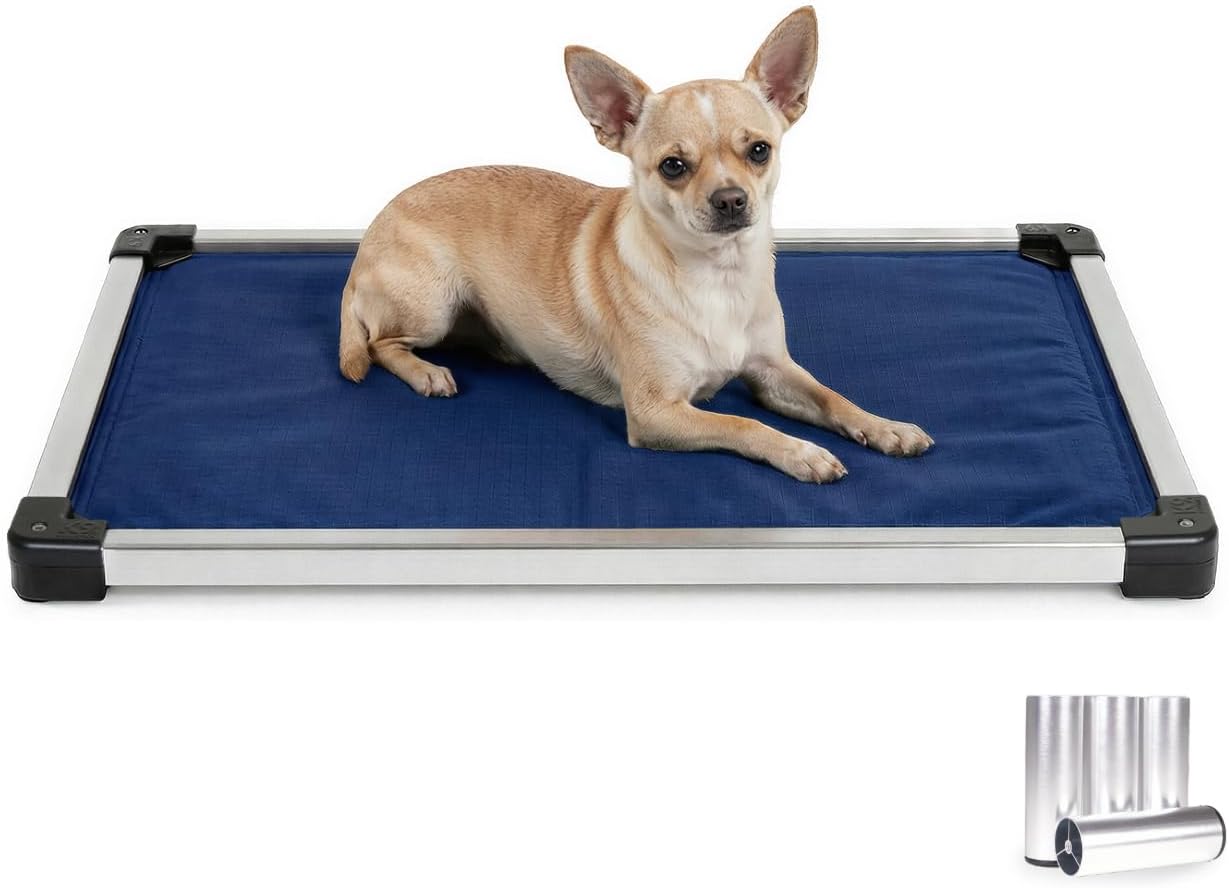
Our pick for the chewer: K9 Chew Proof Armored Padded Dog Crate Bed, S, Blue Quartz
 Visit on Amazon →
This one is a crate pad, and the small size in the name is not a detail you can ignore. It is built for a puppy crate or a smaller dog, not for the main bed of a 95-pound golden. If your golden is a bedding destroyer, the right move is a chew-resistant pad in the crate and a separate, sturdier bed for the living room.
The pitch here is the armored shell and the chew proof claim, which is exactly the kind of marketing language that deserves a hard look. Chew proof is a strong word. What you want to see is a cover with no loose seams, no exposed zipper pull, and no stuffing that can be pulled out through a small tear. Check current Amazon price and read the cover material carefully, because the shell is the entire product.
For a puppy in a crate, a small pad like this makes sense. Puppies destroy bedding, and you should not spend senior-bed money on a bed that will be chewed before the dog is done growing. Buy the inexpensive pad now, upgrade when the chewing stops.
Flaws but not dealbreakers: The small size limits this to crates and small dogs. If you need a bed for the floor of a living room where a 90-pound dog sleeps, this is not that product.
The step-by-step: how to choose and set up a golden's bed
Step one: Measure the dog. Nose to the base of the tail while the dog is lying flat. Add 8 to 12 inches. Biscuit measures 40 inches stretched out, which is why a 36-inch bed is useless to him. This is the step almost everyone skips, and it is why so many large dogs sleep half on the floor.
Step two: Measure the floor. Where does the bed actually go? A crate pad has to match the crate tray, not the dog. A floor bed has to clear the doorway, the coffee table, and the wall your dog likes to lean on. Measure before you order, because a bed that does not fit the space becomes a bed that lives in the garage.
Step three: Set a foam floor and do not go below it. Three to four inches of thickness and three pounds per cubic foot of density is the minimum I will recommend for a dog over 60 pounds. Two inches of foam is not an orthopedic bed. It is a mat, and it will flatten under a golden within a season.
Step four: Read the cover label before the product description. Machine washable and dryer safe. Maple's skin reacts to dust and dander, so her cover goes through a hot wash twice a month, and a cover that cannot survive that is a cover that ends up in the trash. If the listing does not say the cover comes off, assume it does not.
Step five: Check the zipper. Open it, close it, and look at how it is sewn in. Zippers are the first thing to fail on a washable bed, and a bed with a dead zipper is a bed you cannot clean. If you are handy, a zipper can be replaced. If the fabric around it has torn, it cannot.
Step six: Check the warranty and how the brand behaves. A long warranty means nothing if the company fights every claim. Look at what is actually covered, foam flattening included or not, and look for owners reporting that the brand honored it. Warranty behavior tells you more about a company than any product page.
Step seven: Run your own sink test. When the bed arrives, press your knee into the middle and measure how far it sinks. Write the number down with the date. Do the same thing every six months. When the sink depth doubles, the bed is done, and you will know it before your dog starts sleeping on the floor instead.
Step eight: Set it up where the dog already sleeps. Watch your dog for a day and put the bed where he already lies down. That spot is his base of operations, and a bed in the wrong corner of the room will sit empty while he sleeps on the rug. Non-slip backing helps on hardwood, and a bed that slides across the floor when a 95-pound dog jumps on it is a bed that ends up against the wall.
What I left out and why
Donut beds and bolster beds are fine for small dogs and useless for goldens. A 95-pound dog turns a donut into a pancake with a rim. Bolsters can be nice for head resting, but Biscuit ignores his and lies across the whole bed anyway, so I do not pay extra for one.
Cooling gel beds can help in a Colorado summer, but the cheap ones burst. If you go that route, buy from a brand that will replace a leaking bed, and put a towel under it for the first month.
I also left out every bed that will not publish a foam spec. If a listing tells you it is premium and orthopedic and does not tell you the density, it is telling you exactly how much it thinks of your time.
What this costs
The honest comparison is cost per day. If a bed costs three hundred dollars and holds its shape for four years, that is about 20 cents a day. If a sixty-dollar bed turns into a pancake in four months, that is about 50 cents a day, and you still have to buy the next one. The expensive bed is the cheaper bed. You just pay for all of it at once.
For a puppy, spend as little as you can stand on the crate pad and put the money toward the bed you will buy when the chewing stops. For a six-year-old golden, spend now. Check current Amazon price on both beds above, run the foam spec and the cover label through the checklist, and let the numbers pick the bed.
That is the whole job. Measure the dog, measure the foam, wash the cover, and write the sink depth in a notebook. A golden retriever dog bed is not a luxury item. It is the piece of gear your dog uses more than any other, and it deserves the same scrutiny you would give a pair of boots you plan to wear every day for four years.