Most golden retriever dog beds are pancakes by month four. I know because I measured them. I keep a notebook with dates and inches in it, and the pattern is boringly consistent: the cheap "orthopedic" mat loses half an inch in six weeks, then three quarters of an inch by month five, and by the time the dog is finally comfortable on it, the foam has flattened into something closer to a rug with a zipper.
A golden retriever is a 60 to 95 pound dog with a deep chest, heavy elbows, and a habit of flopping down like a dropped sack of feed. Foam that survives a pug does not survive that. This is a how-to, not a shopping list. I'll show you how I evaluate a bed before either of my dogs gets near it, how to size it so your golden actually fits, and where the two beds below fit in a real rotation. Biscuit is 95 pounds and destroys things. Maple is 60 pounds with sensitive skin. Everything here has been through both of them.
Why you should trust me
Eight years as a vet tech, ten years writing about beds full time, and over 60 beds tested. I own two Big Barkers and paid full price for both. I don't take money to change a verdict, and if a brand sends me something I say so in the post.
More importantly, I measure. My notebook has sink depth on arrival, at three months, and at six months for every bed in the house. When I say a bed flattened, I mean I put a ruler on it. When I say a cover survived ten washes, I weighed it before and after. Reviews without numbers are just enthusiasm, and enthusiasm doesn't tell you anything about month seven.
How I picked and how I tested
I'm not reviewing 60 beds here. I'm showing you the workflow I use on every bed, and then two beds that passed it for specific jobs in a golden's day.
Every bed that comes into this house goes through the same sequence. It gets measured out of the box. It gets a sink test with my own body weight. It gets washed on the cover's recommended setting and re-weighed. It gets six months of Biscuit, who has destroyed a mattress pad, two zippers, and one bed that the manufacturer described as "premium."
The numbers I trust are simple. Foam density between 3 and 4 pounds per cubic foot is real furniture-grade foam. Density of 1.5 to 2 pounds per cubic foot is a marketing number wrapped around a sponge. Four inches of thickness is the floor for a golden. Sink depth that grows by more than an inch over six months means the foam is done, no matter what the warranty says.
The two beds I'd put in a golden's rotation
Neither of these is the whole answer for every golden, and I'd rather tell you that up front than pretend otherwise. One is a comfort bed for a dog that curls. One is a crate bed built for the dog that chews. A 95 pound sprawler with hip issues still needs a thick slab bed as a base of operations. These two fill the jobs around it.
The cuddler pick: Bedfolks Calming Fluffy Donut Dog Bed for X-Large Dogs,Dark Grey,45" Round
 Visit on Amazon →
I have a rule that donut beds are for small dogs, because a 90 pound golden turns one into a pancake with a rim. This one is the exception I make, and the reason is the 45 inch round footprint. At that diameter, a golden who sleeps curled can actually fit inside the ring instead of draping over it. Maple claims it most afternoons. Biscuit uses the rim as a chin rest and then lies across the whole thing anyway, which is his answer to every bed I've ever bought.
The honest caveat: beds in this style are usually filled with loose fiber rather than a solid foam slab, so this is a comfort and nesting bed, not an orthopedic one. Before you buy, check the listing for two things I check first. What the fill is, and whether the cover comes off for machine washing. If the cover doesn't come off, I don't care how fluffy it is, because a golden's bed collects drool, dirt, and that specific dog smell within about three weeks.
"Calming" is a marketing word. What actually calms a dog is a bed that smells like home and gets washed on a schedule. Do that part and the fluff does the rest.
Flaws but not dealbreakers: Loose fill compresses over time, so expect to fluff it back into shape and expect the loft to drop. This is a secondary bed, not the main event for a heavy dog with joint problems.
Anyone with a golden who curls into a ball, or a house with a spot in front of the fireplace that a dog has already claimed, will get real use out of this one.
The crate pick: GASUR Indestructible Chew-Proof Dog Bed for Medium Dogs, Durable Crate Bed
 Visit on Amazon →
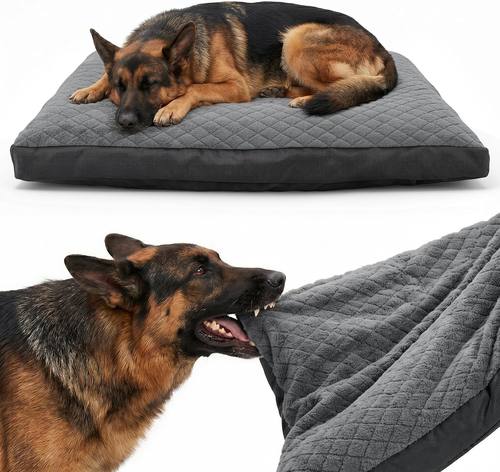
This is the bed for the chewing phase, and the crate. Every golden goes through a stretch, usually somewhere between seven months and two years, where soft bedding becomes a project. I've watched a dog pull the stuffing out of a bed through a hole he made in the seam in under 20 minutes. A tougher cover is the difference between a bed that lasts a year and a bed that lasts a weekend.
Two things to know before you order. First, this one is sized for medium dogs, so it belongs in a crate or with a golden puppy, or with a smaller-framed adult. A 95 pound Biscuit does not fit on it as a main bed, and I'm not going to pretend he does. Measure your crate interior and your dog, in that order, and buy to the smaller number.
Second, "indestructible" and "chew-proof" are marketing words, and I've never met a cover that a determined dog couldn't eventually defeat. What a bed like this honestly gives you is a cover that resists the casual destruction that kills cheaper beds, which is a real and worthwhile difference. Check the listing for the cover material and for whether the cover is removable and washable. A chew-resistant bed with a cover you can't wash is still a bed you'll throw out early.
Flaws but not dealbreakers: Chew-resistant covers are usually stiffer and warmer than a fluffy fleece, so a dog that likes to nest may ignore it at first. Give it a week and put a familiar blanket on top.
Anyone crating a puppy, or living with an adolescent golden who treats bedding as a chew toy, should start here instead of buying a third cheap bed this year.
The actual how-to, step by step
Now the workflow. This works on any bed, at any price, and it takes about 15 minutes plus a ruler.
Step one: Measure the dog, not the box. Measure nose to tail while your golden is stretched out flat, then add 8 to 10 inches. Biscuit runs 38 inches nose to tail and needs a bed at least 48 inches long to sprawl. Measure chest to rump too, because a curler needs diameter, not length. If the bed goes in a crate, measure the crate interior and subtract an inch on each side.
Step two: Find the foam spec. Look for density in pounds per cubic foot. That's the number that predicts whether the bed is still a bed in year two. If a listing doesn't state thickness and density, that's your answer. Buy something else.
Step three: Check the cover before anything else. Machine washable, removable, decent zipper. This is my dealbreaker and it should be yours. A bed you can't wash is a bed that gets thrown out for reasons that have nothing to do with foam.
Step four: Sink test on arrival. Lie on it. Put a ruler next to your hip and note how far the foam compresses. Write the date and the number down. That single entry is the baseline for every future comparison.
Step five: Wash it once and weigh it. Weigh the cover before and after the first wash. If it comes out heavier, the fill is holding water and it will hold odors the same way.
Step six: Email the warranty department before you buy. Ask one question about coverage. The reply speed and tone tell you more about a brand than any badge on the box.
Step seven: Set the two-year bar. A bed that dies at month four is not a bargain at any price, and a bed that holds its shape for two years is cheap no matter what the listing says. Divide the price by 730 days. That's the only honest comparison.
Step eight: Re-measure at six months. Sink depth up by more than an inch means the foam is done. Rotate the bed, flip it, or start shopping.
Mistakes I see in the golden retriever groups
The same five problems show up over and over, and every one of them is avoidable.
Buying two inches of foam because the listing says "orthopedic." Two inches is a mat. Orthopedic is a spec, not a label.
Trusting the word "waterproof" without reading how the cover is finished. Covers that rely on a coating rather than a membrane tend to delaminate after a wash or two.
Sizing to the puppy. A golden at five months is not the dog you'll have at two years. If you're buying for a puppy, buy a cheap crate bed and upgrade once the chewing stops and the growth plateaus.
Buying a donut as the only bed for a heavy sprawler. Round beds reward curlers. If your golden sleeps stretched out with his legs in four directions, he needs length and a slab.
Washing hot and drying on high. Heat is what kills foam. Cold wash, air dry, every time.
What this costs over two years
Here's the math that actually matters, and it doesn't require a sticker price. Take whatever the listing shows today, divide by 730 days, and you have your cost per day. Now do the same for the cheap bed you'd replace twice in that window, and add the cost of the two replacements plus your time and the landfill trip.
I've run this comparison for a decade. The bed that survives two years with a 90 pound dog wins almost every time, even when it costs several times more up front. Cheap gear costs twice as much in the long run, and the second payment is the one that stings, because you make it while you're annoyed.
If you can't spend much right now, spend it on the crate bed and the cover quality, not on the thickness of the foam. A washable cover and a tougher fabric do more for a young golden than an extra inch of cheap fill.
The bottom line
Buy for the dog you have, measure before you buy, and write the numbers down so you're comparing data instead of feelings. The donut earns its spot with a curler and a washer that runs cold. The crate bed earns its spot with a chewer and a tape measure. Neither one is a substitute for a real slab bed under a 95 pound senior with sore hips, and I'd rather say that plainly than sell you the wrong thing.
Measure the dog, check the cover, wash it once, and put a ruler on it at six months. That's the whole job, and it's the difference between a bed and a donation to the landfill.