Most beds sold for big dogs are mats with ambitious box copy. I have spent ten years measuring foam, washing covers, and watching a 95 pound golden turn a jumbo orthopedic bed into a pancake in under four months, so my list of things I trust is short.
If you are shopping for a golden retriever dog bed, the decision comes down to four measurable things: foam thickness, foam density, whether the cover survives a washing machine, and whether the bed is wide enough for a dog that sleeps sprawled out instead of curled. Everything else on the product page is decoration.
This is the workflow I run before I spend money, and it takes about twenty minutes, one tape measure, and one bathroom scale. It works for a floor bed in the living room and for a crate pad for a dog that still chews.
Why you should trust me
I was a vet tech for eight years before I started writing reviews full time, and I live in Colorado with two goldens: Biscuit, 95 pounds and six years old, and Maple, 60 pounds and three years old with skin that reacts to everything. I have tested more than 60 dog beds in ten years, and I keep a notebook with real dates and real numbers in it. Foam sink depth gets measured every six months. Covers get weighed before and after washing.
That background shapes what I care about. I see a large dog's hips and elbows as something that will eventually become a patient, not a marketing opportunity. I am not a vet and I will not give you medical advice, but I will tell you when a bed is going to put pressure where a golden does not need it.
I also do not take money to change a review. If a brand sends a product, I say so. Nobody sent anything for this piece.
How I picked and how I tested
Before I open a listing, I decide what the bed has to do. For a golden that means supporting 60 to 95 pounds across a wide frame, surviving two years, and going into a washing machine without the waterproof layer peeling off.
The numbers I check first:
- Foam density in pounds per cubic foot. Three to four is good. One and a half to two is a scam with a nice photo.
- Foam thickness. Four inches minimum for a large dog. Two inches is a mat.
- Cover construction. A zipper you can actually open, and a fabric that does not delaminate after one wash.
- Interior dimensions. A dog should be able to lie flat with room to spare, not curl into a ball against the edge.
The two beds below are the ones I would point a golden owner to first, for two different jobs. I have not owned either of these exact units, so treat every spec as a claim to verify the way I do it: tape measure on day one, first wash in month one.
The two beds I would start with
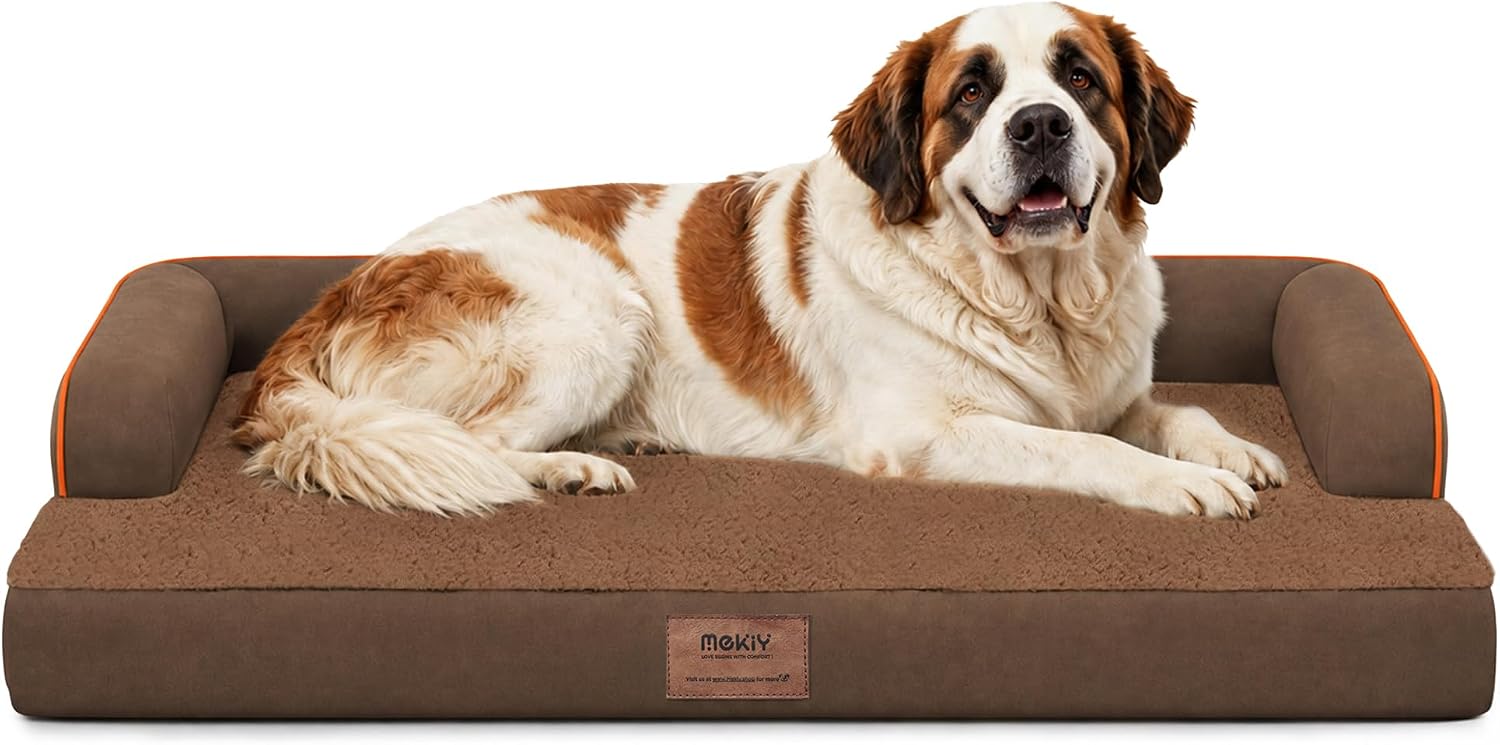
Our pick for floor sleepers: MEKIY Orthopedic Waterproof Jumbo Dog Bed with Bolster for Extra Large Dogs
 Visit on Amazon →
This is the shape I want for a golden that sleeps on the living room floor: a jumbo footprint, a bolster around the edge for head resting, and a waterproof cover, which matters more than people think when a 95 pound dog comes in from the snow with wet fur.
Two things to verify on arrival. First, open the cover and put a tape measure against the foam. If the foam is under four inches, send it back, because a jumbo cover wrapped around a thin slab is the most common way this category cheats. Second, run the sink test. Press a knee into the middle and watch how far it compresses. If you bottom out onto the floor, the dog will too.
The bolster is the one feature I would call optional. Biscuit ignores bolsters and lies across the whole bed anyway, but Maple rests her chin on one and stays there for hours, so it depends on the dog.
Flaws but not dealbreakers: Bolster beds take longer to wash and dry because the rim holds water. Plan on a full afternoon for the first wash, not an hour.
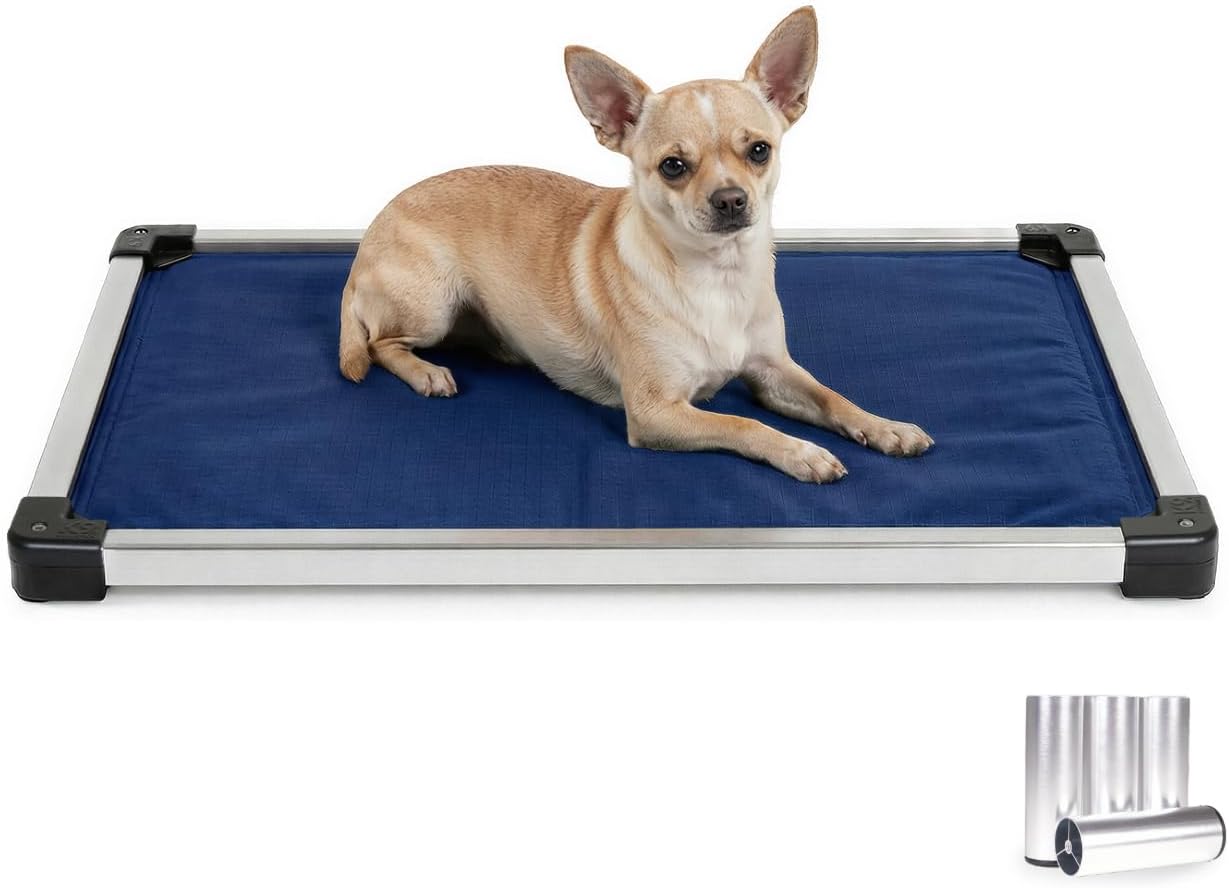
Runner-up for crate sleepers: K9 Chew Proof Armored Padded Dog Crate Bed, S, Blue Quartz
 Visit on Amazon →
Different job, different bed. A crate pad gets chewed, peed on, and dragged out of the crate, so armor and washability matter more than plush.
Be honest about the size, though. This one is a small. A small armored crate bed fits a puppy, a senior golden who curls tight, or a dog that uses the crate mainly for travel and naps. It is not the pad for a 95 pound adult that sprawls. If that is your dog, size the pad to the crate floor, not to the weight class printed on a product page.
Chew proof in this category means the shell is tougher than fabric, not that it is indestructible. Biscuit has destroyed things marketed as indestructible, and a determined dog can work a seam if left alone with it for an afternoon. Supervise the first week.
Flaws but not dealbreakers: Armored fabric is stiffer and less cozy than a plush cover, so some dogs take a few nights to settle on it.
The step by step workflow
Step one: Measure the dog, not the bed
Measure your golden from the base of the tail to the front of the chest while standing, then add 8 to 12 inches of slack. A dog that can sprawl sleeps better than a dog folded onto its own paws. Then measure the crate interior and subtract an inch so the pad does not jam against the door.
Step two: Ask for foam density in pounds per cubic foot
This number decides whether a bed is a bed or a temporary mat. Three to four pounds per cubic foot holds up. One and a half to two pounds flattens. If the listing does not state density, assume the low end, because brands that pay for good foam put the number on the page.
Step three: Check the thickness with a ruler
Four inches is the floor for a golden. Anything advertised as orthopedic with two inches of foam is a mat with big letters on the box. Measure it yourself when it arrives, because compressed shipping can make foam look thicker in photos than it is in your hallway.
Step four: Read the waterproof claim carefully
Waterproof usually means one of two things: a coated fabric that beads water, or a liner under the cover. Coated fabrics breathe less and can delaminate in a hot wash. A removable liner is the safer design for a dog with sensitive skin. If the listing does not say which one it is, that is your answer.
Step five: Check the cover for a real zipper
If I cannot wash the cover, I will not buy the bed. Look for a zipper that runs the full length of one side and a cover that comes off without a wrestling match. A zipper is also the most repairable part of a bed, and a replacement zipper costs far less than a new bed.
Step six: Size the crate pad to the crate
A crate pad should fill the crate floor with no gaps at the corners and no bunching at the door. Too small and the dog sleeps on the tray. Too big and you fight it every time you close the crate.
Step seven: Set a two year standard before you buy
Write the date on the receipt, or in my case, in the notebook. Two years with a 90 pound dog is the minimum for a bed to count as a bed instead of a toy. At six months, measure the sink depth again. If the foam has lost more than an inch, you learned something about that brand.
Step eight: Wash it in the first month
The first wash is the honest test. A waterproof cover that delaminates, a zipper that pulls out, or a shell that shrinks all show up in month one, while you can still return it. Wash cold, air dry when you can, and check the seams while the cover is inside out.
Where people go wrong
- Buying by photo. A small dog on a jumbo bed tells you nothing about the foam inside it.
- Trusting the word orthopedic. It is not regulated. Two inches of soft foam qualifies.
- Skipping the wash until month eight, when the return window is gone.
- Buying a donut bed for a big dog. A 90 pound golden turns a donut into a pancake with a rim.
- Assuming cheap cooling gel is a bargain. Cheap gel bursts and you mop it off the floor.
The competition and why it lost
Donut beds are the first thing people recommend for goldens and the last thing I would buy. They suit small dogs. A big dog flattens the center and ends up sleeping on a ring of fabric.
Cooling gel beds have a real place in a Colorado summer, but only the ones with a properly sealed gel layer. Cheap ones burst.
Flat mats and crib style pads are fine for a puppy who will destroy whatever you hand it. Buy cheap, expect four months, and upgrade when the chewing stops.
The boutique beds with a ten year warranty are not wrong either. I own two of them and they still hold shape after two years. They are just a different budget conversation, and the cost per day math only works if you keep the dog for the life of the bed.
What this all costs
Cost per day is the only honest price comparison. Sticker price is what marketing wants you to look at. Divide what you pay by the number of days the bed actually lasts and the arithmetic stops being emotional:
- A cheap bed that dies in four months costs more per day than a good bed that lasts three years.
- A cover you can wash extends the life of the bed by years, which is free money.
- A zipper replacement costs a fraction of a new bed, if the cover is built to be opened.
For most golden owners the honest target is the middle: real foam, a washable cover, and a size that fits a dog who sprawls. Check current Amazon price on both beds above before you decide, then put a tape measure against the foam the day the box arrives.
The short version
Measure your dog, demand four inches of dense foam, confirm the cover comes off, and give the bed two years to prove itself. If it survives two years with a 95 pound golden, it earned its place as the base of operations. If it flattens in four months, it was a donation to the landfill, and now you know that before you buy the next one.